Guide · September 10, 2026
Social media management software for agencies in 2026
Discover how social media management software for agencies evolved in 2026. Compare workspace isolation, approval workflows, pricing, and AI autopilot tools.
 By Sergio · Co-founder of Quetzal

Social media management software for agencies must solve two operational bottlenecks: administrative isolation across client accounts and high-volume asset production. Unlike software designed for single brands, an agency platform requires multi-tenant workspaces, frictionless client approval mechanisms, multi-network publishing, and pricing structures that do not penalize account expansion.
In 2026, the tooling landscape divides between legacy scheduling dashboards that distribute manually uploaded media and autonomous production platforms that generate, schedule, publish, and iterate creative content directly.
Quetzal handles this operational bottleneck by generating designed static posts, carousels, captions, and end-to-end video reels matching each client's specific visual identity, then scheduling and publishing them across six major networks.
Agencies manage separate workspaces with portfolio discounts starting from the third client, with the option to try it free on your own website to see how autonomous production functions across client accounts.
Choosing the right platform determines an agency's gross margins. When an agency relies on fragmented tools for copywriting, graphic design, video editing, scheduling, and reporting, labor hours scale linearly with client acquisition. Selecting software built around agency workflows protects operational margins and prevents team burnout.
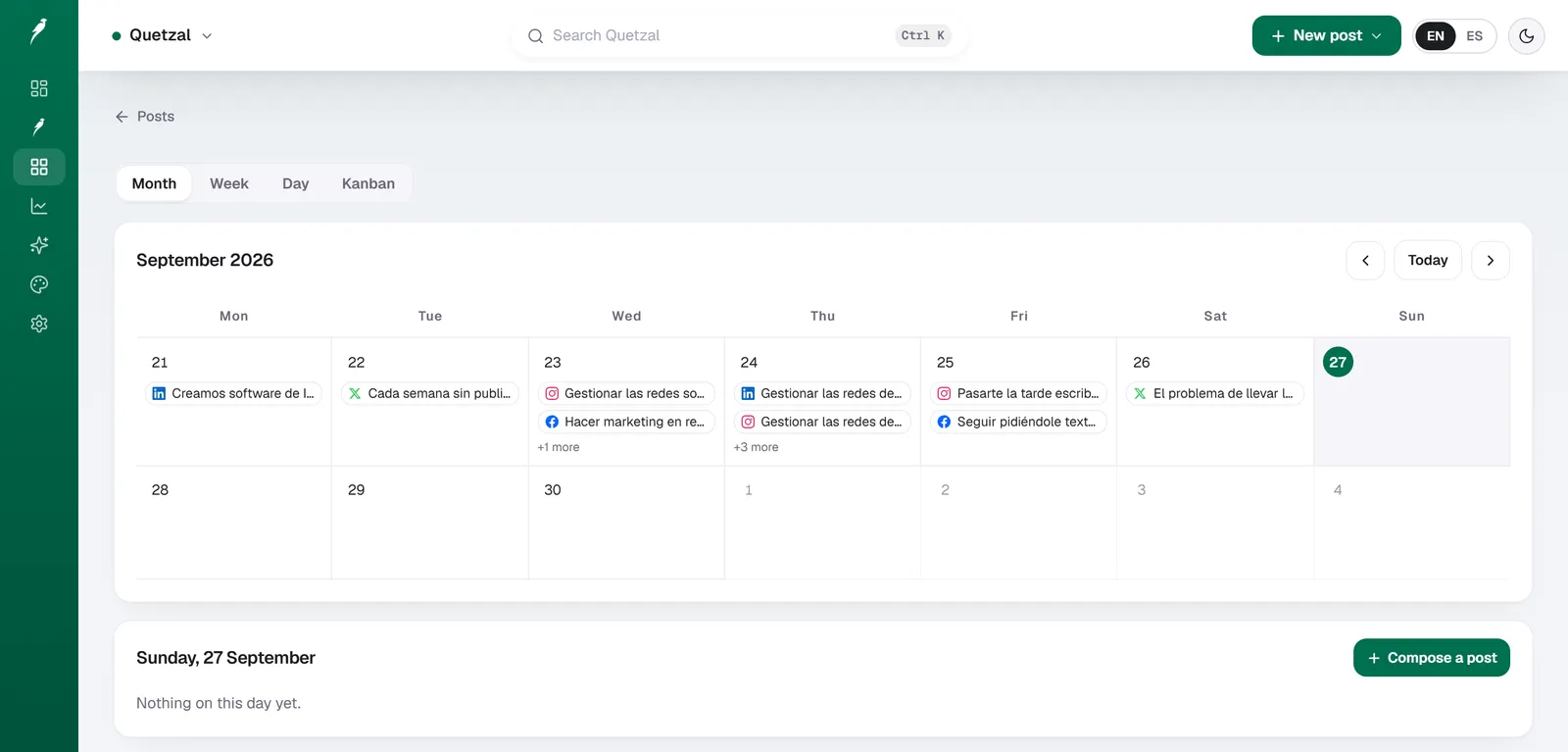
The Quetzal calendar on our own account in September 2026: every post the autopilot planned for LinkedIn, X, Instagram and Facebook, and underneath, the posts still waiting for approval. Our account publishes in Spanish.
What separates agency software from single-brand tools
Single-brand social media tools prioritize individual account convenience. They assume a single creative voice, a unified visual identity, and internal team collaboration. In contrast, marketing agencies manage dozens of distinct brands simultaneously, each with independent legal ownership, bespoke visual identities, and unique stakeholders.
To serve an agency effectively, software must provide five architectural capabilities:
- Strict workspace isolation: Team members and clients must only access authorized brands. Cross-account data leaks, such as scheduling a post to the wrong brand's profile, represent critical failures.
- Client-facing review workflows: Agencies need portals where external stakeholders can review, comment on, and approve drafts without requiring paid administrative seats.
- Multi-network coverage: Software must support native publishing across all major platforms, including Instagram, Facebook, LinkedIn, TikTok, X, and YouTube, without forcing teams to manually complete publishing on mobile devices.
- Predictable multi-client pricing: Per-seat pricing models erode agency profitability as account teams grow. Platforms designed for agencies offer per-workspace pricing or aggregated portfolio tiers.
- Asset and brand memory: The software must store individual brand kits (typography, color palettes, vector logos, and imagery) and enforce these constraints across all output.
Agencies evaluating tool stacks often balance feature depth against cost. For a broader comparison of traditional scheduling and monitoring suites, see our analysis of the best social media management tools for agencies in 2026.
The shift from manual distribution to autonomous production
For over a decade, social media software operated strictly as a distribution pipe. Tools such as Buffer, Hootsuite, and Later allowed managers to stage pre-rendered images, paste pre-written captions, set a time slot, and push content through official platform APIs.
This model created an operational bottleneck: the software contributed zero assistance to creative generation. The agency remained responsible for writing copy in external documents, designing graphics in layout software, editing short-form video in timeline editors, and manually transferring files to the scheduler.
In 2026, modern agency software handles creative generation alongside distribution. Instead of functioning merely as a calendar, an autonomous engine ingests brand assets, understands product positioning, and generates complete creative units:
- Static graphics and carousels: The system formats multi-slide educational carousels, promotional banners, and infographics aligned to exact brand guidelines.
- End-to-end video production: Rather than requiring external video teams for daily short-form video, advanced platforms script, voice, caption, and edit vertical video reels natively.
- Contextual captions: Captions are authored with native platform vernacular, proper hashtag density, and conversion-focused calls to action.
- Closed-loop measurement: Rather than compiling passive monthly reports, modern systems monitor performance data at set intervals to adjust creative direction automatically.
Agencies exploring this operational transition can read more about restructuring services in our guide on how to choose a social media automation agency.
Evaluating software by client approval models
Client management is often the most time-consuming phase of social media execution. An agency's operational velocity depends heavily on how the software manages review cycles. Agencies typically encounter three approval models:
1. Manual external exports
The agency builds content inside the scheduling tool, exports mockups to spreadsheets or PDF decks, emails them to the client, collects feedback asynchronously, and manually applies changes inside the scheduler. This workflow introduces human error, version mismatches, and severe administrative overhead.
2. Client-seat review portals
Traditional platforms provide client login credentials into the core dashboard. While this eliminates external spreadsheets, it introduces new friction: clients face complex interfaces filled with analytics and scheduling modules they do not need.
Additionally, enterprise platforms frequently charge expensive add-on fees for external guest seats. For teams evaluating pricing relief from legacy enterprise systems, review our assessment of Sprout Social alternative free and budget options.
3. Asymmetric autopilot controls
The most modern agency platforms allow customizable governance per client. For cautious or highly regulated accounts (such as legal, finance, or healthcare clients), the software routes every post through a dedicated, lightweight approval link where the client approves or requests revisions in a single click.
For established accounts with agreed-upon brand parameters, the agency can place the account on full autopilot, allowing the software to generate, schedule, and publish content within pre-set brand guardrails autonomously.
Agency software models compared
The table below contrasts the four primary software models agencies employ in 2026:
| Software Category | Representative Examples | Content Creation Capabilities | Client Approval Flow | Scalability for Agencies |
|---|---|---|---|---|
| Traditional Schedulers | Buffer, Later | None (Requires external design and copywriting) | Minimal; basic internal notes or external spreadsheets | Linear costs; affordable entry, but labor hours scale with clients |
| Mid-Market Management | Metricool, Publer | Basic text suggestions; primarily distribution | Shared calendars, basic client approval links | High cost-efficiency for scheduling; high internal production labor |
| Enterprise Suites | Hootsuite, Sprout Social | Basic templates; heavy listening and social CRM | Granular role permissions; costly external user seats | Poor margin scaling due to aggressive per-seat and profile pricing |
| Autonomous AI Autopilots | Quetzal | Full generation: carousels, static posts, copy, and end-to-end video reels | Choice between full autopilot or single-click per-post review | High margin scaling; portfolio discounts per client workspace |
How agencies protect margins through automated creative execution
An agency charging a monthly retainer of $1,500 to $3,000 per client typically allocates 15 to 25 hours per month to each account. In a manual workflow, that time is divided across several roles:
- 4 to 6 hours for ideation, copywriting, and research
- 5 to 8 hours for static design, carousel layout, and video editing
- 2 to 3 hours for staging posts, configuring links, and scheduling
- 2 to 4 hours for client communication, approval revisions, and manual publishing
- 2 to 4 hours for monthly analytics aggregation
Under this structure, a social media manager can handle roughly four to six accounts before quality degrades or delivery dates slip. Software licensing costs compound this constraint if the platform charges per user seat or charges separate fees for video features.
Agencies adopting an autonomous software layer alter this financial equation. By adopting tools that draft visual assets, captions, and reels according to client brand rules, the initial 15 hours of production collapse to under two hours of editorial direction and quality review.
Platforms like Quetzal, an AI social media autopilot built in Málaga, Spain, by two founders, address this production bottleneck directly.
Quetzal operates on a workspace model tailored for agencies, generating designed static posts, ads, carousels, infographics, stories, and captions inside the brand's visual identity (including logo, palette, typography, and uploaded product imagery).
It publishes across Instagram, Facebook, LinkedIn, TikTok, X, and YouTube, while evaluating every post at 1, 6, 24, and 72 hours to refine future creative batches.
Quetzal also generates end-to-end AI video reels, producing the script, AI voiceover, word-synced subtitles, and rendered media in a single workflow.
For agencies scaling client rosters across Spain, Europe, and the United States, Quetzal provides native authoring in both English and Spanish, maintaining client workspaces with portfolio discounts beginning at the third client.
Pricing is predictable: Starter is 79 EUR/month billed annually ($89 USD/month), Growth is 199 EUR/month ($229 USD/month), Pro is 449 EUR/month ($499 USD/month), and Ultra is 899 EUR/month ($999 USD/month), backed by a 7-day free trial, card required, nothing charged today.
By shifting production mechanics into the software layer, account managers can oversee 15 to 20 client accounts without compromising creative output or agency margins.
Key functional criteria when auditing platforms
When selecting software to run an agency's social media operations, prioritize these technical capabilities:
1. Dynamic brand asset isolation
The system must maintain discrete brand kits for every client. Ensure the platform locks specific hex palettes, font pairings, and logo placements so that AI generation or templating cannot blend visual styles across client accounts.
2. High-fidelity video generation
Short-form video drives the highest distribution on modern networks, yet video editing is an agency's most expensive production cost. Look for software capable of generating vertical video from scratch, incorporating professional voice synthesis and dynamic subtitles, rather than tools that merely reformat static images into video slideshows.
3. Native multi-platform scheduling
Publishing workflows must handle the distinct API requirements of Instagram, TikTok, LinkedIn, YouTube, Facebook, and X. Software requiring push notifications to an account manager's personal mobile phone introduces operational bottlenecks and weekend delivery risks.
4. Algorithmic iteration loops
Basic social software presents vanity metrics (likes, impressions) in passive charts. Agency-grade systems analyze post performance at structured intervals (such as 1, 6, 24, and 72 hours) and use engagement signals to dynamically optimize upcoming content angles, visual formats, and posting schedules.
5. Multi-client commercial terms
Avoid software providers that charge per user seat. As an agency grows, you will add junior copywriters, account executives, and client reviewers. Software that bills per client workspace or offers tiered portfolio discounts keeps operational costs aligned with incoming retainer revenue.
To explore how agencies configure multi-client setups, workspaces, and portfolio discounting, review the features available on Quetzal's marketing agency suite.
Test automated client production on your agency roster
Quetzal handles creative execution directly instead of merely organizing uploads, generating static posts, carousels, stories, captions, and complete AI video reels in each client's specific logo, color palette, fonts, and product photos.
It publishes across six networks (Instagram, Facebook, LinkedIn, TikTok, X, and YouTube) while evaluating every post at 1, 6, 24, and 72 hours so future content continually improves.
Agency teams retain complete governance through optional per-post client approval links or autonomous posting under standing guidelines, backed by portfolio discounts from the third client.
To see how it formats content for your brand guidelines, enter any client website at the free Quetzal demo to generate a full week of branded content in about 3 minutes without signing up.
Frequently asked questions
How do agencies manage client approvals without purchasing extra software seats?
Agencies prevent runaway software costs by choosing platforms that separate administrative user seats from client review portals. Modern tools generate lightweight, secure external approval links or guest portals.
Clients can review upcoming drafts, request copy tweaks, or approve posts for publication directly through their mobile browser or desktop without logging into an administrative dashboard or triggering additional seat fees.
Can AI social media software maintain distinct brand voices across diverse client niches?
Yes, provided the software utilizes dedicated client workspaces with separate brand identities rather than generic prompting. Effective platforms ingest distinct brand guidelines for each client, including industry terminology, target audience profiles, core value propositions, color palettes, fonts, and uploaded product assets.
Advanced engines native to both English and Spanish generate copy and visual layouts that adhere strictly to those isolated parameters.
What social networks should agency management software support in 2026?
Agency software must maintain native API publishing across six primary networks: Instagram (Posts, Carousels, Stories, and Reels), TikTok, LinkedIn (Company Pages and Personal Profiles), Facebook, YouTube (Shorts), and X. Tools that lack direct video publishing or require manual mobile handoffs create operational vulnerabilities for agency teams managing multi-client schedules.