Guide · September 10, 2026
Social media automation agency: how to choose one
What a social media automation agency actually does, what it costs, and how to tell a real one from a scheduling tool with a service wrapper.
 By Sergio · Co-founder of Quetzal

A social media automation agency is a company (or a piece of software acting like one) that generates, schedules, publishes and improves your social content with minimal manual work, instead of billing hours for someone to type posts into a scheduler.
The good ones combine on-brand design, AI copy and video, and performance tracking that actually feeds back into next week's content. The bad ones are a Canva subscription and a calendar app wearing a blazer.
Quetzal handles this entire production cycle as software, generating on-brand posts, carousels, captions and video reels that match your existing logo, palette and fonts before publishing to six networks. It then measures each post at 1, 6, 24 and 72 hours to plan the next week around what performed best.
You can try it free on your own website to see how an automated system creates finished assets without billing agency hours.
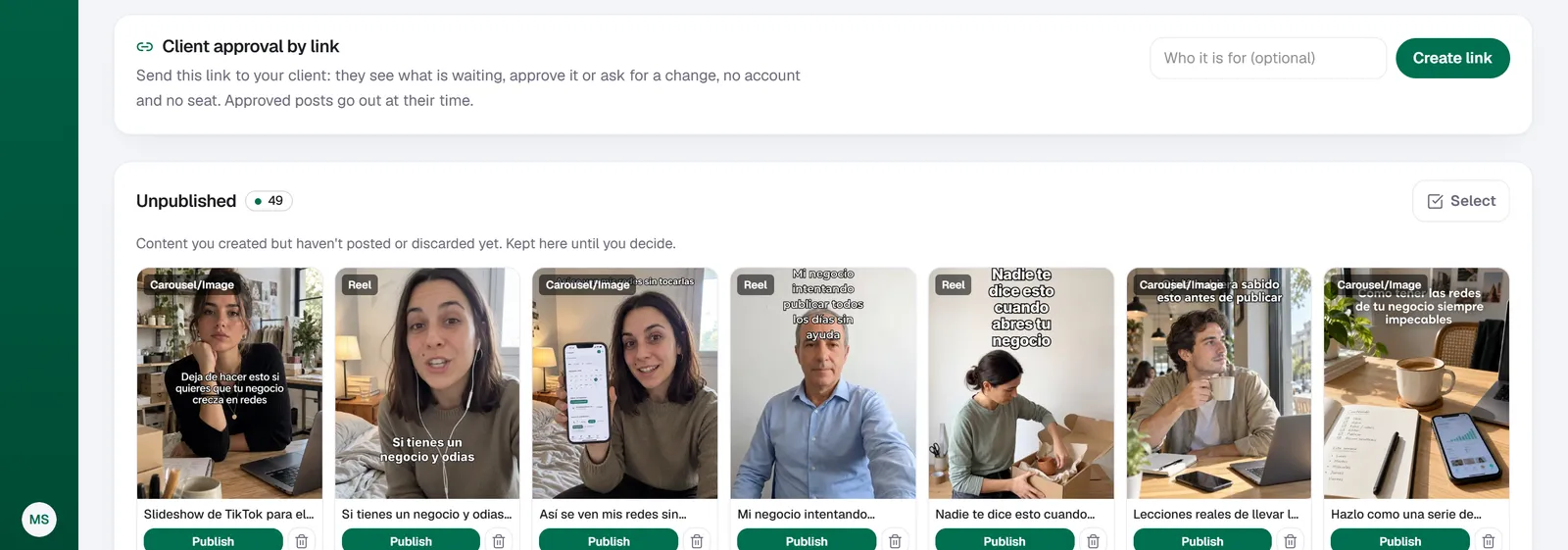
The approval queue in Quetzal: a client approves a post or asks for a change through a link, with no account and no seat, and underneath sits everything created but not yet published.
What does a social media automation agency actually do
Strip away the sales language and the job has four parts:
- Content generation. Static posts, ad creative, carousels, infographics, stories, captions and increasingly full video reels (script, voiceover, captions, edit), produced in the brand's actual visual identity: logo, colors, fonts, product photos.
- Scheduling and publishing. Pushing that content live across the platforms that matter, usually Instagram, Facebook, LinkedIn, TikTok, X and YouTube, at the right times.
- Measurement. Tracking how each post performs, not once, but at intervals that catch both the initial spike and the slower burn, then using that to adjust the next batch.
- Governance. Some businesses want every post approved before it goes out. Others want the system to run under standing brand guidelines and just work. A real automation agency lets the client choose, rather than forcing one workflow.
Quetzal, built in Málaga by two founders, is structured around exactly this loop: it generates posts, ads, carousels, infographics, stories and captions in the brand's own identity, publishes to all six major platforms, and measures each post at 1, 6, 24 and 72 hours to improve the following week.
Autopilot can run fully autonomously or with per-post approval, whichever the customer prefers. That's worth knowing before you evaluate anyone else against it, including traditional human agencies.
Agency vs. software: which one is actually automation
This is the part most comparison articles skip. A "social media automation agency" can mean two very different things:
- A human agency that uses automation tools internally, but still bills for strategist and designer hours.
- Software that does the agency's job directly: generation, scheduling, publishing, measurement, with humans only setting direction and approving output.
If you're paying a retainer and still waiting three days for a carousel, you're not buying automation, you're buying labor with a scheduling tool attached. Real automation means the time between "we need a post about our new product" and "it's live, on-brand, across platforms" is measured in minutes, not a sprint cycle.
This matters most for two groups: small businesses that can't afford a full marketing team, and agencies managing many client accounts who need production that doesn't scale linearly with headcount. For the second group specifically, per-client workspaces and volume pricing change the math; see how that works for agencies running multiple client accounts.
How much does social media automation cost
Pricing splits into three tiers you'll see across the market: free schedulers with paid upgrades, mid-market suites billed per user or per social profile, and AI-native tools billed per workspace regardless of team size.
| Tool type | Typical monthly cost | What you still do manually |
|---|---|---|
| Free/basic scheduler (Buffer, Later free tiers) | 0-15 EUR | Design, copy, video editing, performance analysis |
| Mid-market suite (Hootsuite, Sprout Social, Metricool paid) | 25-300+ EUR, often per seat | Design and video still largely manual, some AI captions |
| AI generation + scheduling + publishing (Quetzal) | 79-899 EUR/month (or $89-$999 outside Europe) flat per workspace | Setting brand direction and approving posts if you choose manual mode |
Quetzal's four tiers, Starter, Growth, Pro and Ultra, run 79, 199, 449 and 899 EUR/month billed annually in Spain and Europe ($89, $229, $499, $999 in the US and outside Europe), each with a 7-day free trial, card required, nothing charged today.
The jump between tiers is about volume and platform coverage, not about unlocking basic design features that competitors gate behind higher plans. Full breakdown on Quetzal's plans.
The real cost comparison isn't the sticker price, it's what you're not paying for separately: a designer for static posts, a video editor for reels, a copywriter for captions, and an analyst to tell you what worked. Tools that only schedule leave all of that as a separate line item.
What should a social media automation agency actually deliver
Ask any candidate, human agency or software, these questions before signing:
- Does it design in our actual brand identity, or generic templates with our logo pasted on top?
- Does it handle video, or just static images and captions? Reels and short-form video now carry a large share of reach on Instagram, TikTok and YouTube Shorts, so a tool that skips video is only doing half the job.
- Does it measure and adapt, or just report vanity metrics after the fact? Measurement that doesn't change next week's content is a dashboard, not automation.
- Can we approve before publishing, or are we forced into either full manual work or full blind trust? This should be a setting, not a limitation.
- Which platforms are actually covered, and does that match where our audience actually is? A tool that only does Instagram and Facebook is not full social automation in 2026.
If the answer to more than one of these is "no" or "extra cost", you're likely buying a scheduler with a marketing label, not automation. For a wider shortlist of tools worth checking against these criteria, see the best social media management tools for agencies.
Is social media automation right for a small business or startup
Yes, with one caveat: automation works best when there's a clear brand identity to automate around. If your logo, palette, and product photography already exist, an automation tool can start producing on-brand content almost immediately.
If you're still figuring out your visual identity from scratch, that groundwork has to happen first, automation amplifies a brand, it doesn't invent one from nothing.
For a business with no in-house designer, copywriter or video editor, the case is straightforward: automation replaces work that would otherwise not get done at all, not work currently done well by a person.
For a business already running an internal marketing team, it's better framed as freeing that team from repetitive production so they can focus on strategy, partnerships and campaigns that need a human judgment call.
Teams migrating off a tool they've outgrown often ask the same question in a narrower form. If you're specifically comparing against Sprout Social or Metricool pricing, the tradeoffs are laid out in a free alternative to Sprout Social and what to use instead of Metricool.
Before you commit to an agency, audit what you already have
Two things worth checking for free before paying anyone: whether your brand actually looks consistent across the profiles you already run, and whether AI assistants like ChatGPT or Perplexity can find and describe your business accurately when someone asks.
Both are five-minute checks: audit brand consistency across your profiles and check your AI visibility. If either comes back messy, fix that before automating on top of it, automation will faithfully replicate whatever inconsistency already exists.
See what automated content looks like for your business
Choosing a social media automation agency comes down to whether software can handle real production without sacrificing quality or brand control.
Quetzal does the creative work instead of just organizing it, generating designed posts, carousels, stories, captions and complete AI video reels using your brand's own logo, palette, fonts and product photos.
It publishes across six platforms from one workspace and measures every post at 1, 6, 24 and 72 hours to continuously improve the next batch. You retain complete control through full autopilot or per-post approvals at a fraction of agency costs, starting at 79 EUR or 89 USD a month.
To see a full week of branded content created for your business in about 3 minutes with no signup, try the free demo.
FAQ
What's the difference between social media automation and social media management?
Management traditionally means a person or team planning, designing and posting content manually, often supported by a scheduling tool. Automation means software handles generation, scheduling, publishing and performance analysis directly, with humans setting direction and approving output rather than producing each post by hand.
The line has blurred as AI generation tools have matured, but the test is simple: if removing the human for a week stops content going out, it's management with a tool; if content keeps flowing on-brand, it's automation.
Can automation tools post video, or only static images?
It depends entirely on the tool. Basic schedulers publish whatever video file you upload but don't create it.
More capable AI tools, including Quetzal, generate the reel end to end: script, AI voiceover, word-synced captions and a finished edited render, then publish it like any other post.
If video matters to your channel mix, confirm this specifically before choosing a tool, "supports video" often just means "can upload an mp4."
How do agencies use automation tools across multiple clients?
Agencies typically run one workspace per client rather than mixing accounts, which keeps brand guidelines, approval settings and performance data separate per business.
Pricing for this model usually includes portfolio discounts that kick in once an agency passes a handful of clients, since the cost of running automation across ten brands shouldn't scale the same way as ten separate human retainers would. Details on how that structure works are on the agency page.