Guide · September 10, 2026
White Label Social Media Content: The Agency Guide (2026)
Learn how to source and deliver white label social media content for agency clients in 2026 without sacrificing design quality or profit margins.
 By Jaime · Co-founder of Quetzal

White label social media content is creative material produced by an external provider or software engine that an agency rebrands, manages, and delivers to end clients under its own identity.
This model enables marketing agencies, consultants, and growth studios to offer complete multi-channel social management without hiring dedicated in-house creative teams. By decoupling client acquisition from manual asset production, agencies protect their service margins while maintaining consistent delivery schedules across multiple brand accounts.
Quetzal handles this workload by creating posts, carousels, captions, and video reels in each client's visual identity rather than using generic templates. It publishes across six networks while letting teams run on full autopilot or approve each post.
Agencies can try it free on your own website to see how the engine builds content.
For agencies navigating rising operational costs in 2026, delivering white label content is no longer limited to hiring offshore freelancer pools or contracting white label boutique agencies. Automated software engines now allow internal agency account managers to generate, review, and distribute brand-accurate assets across major networks in minutes rather than days.
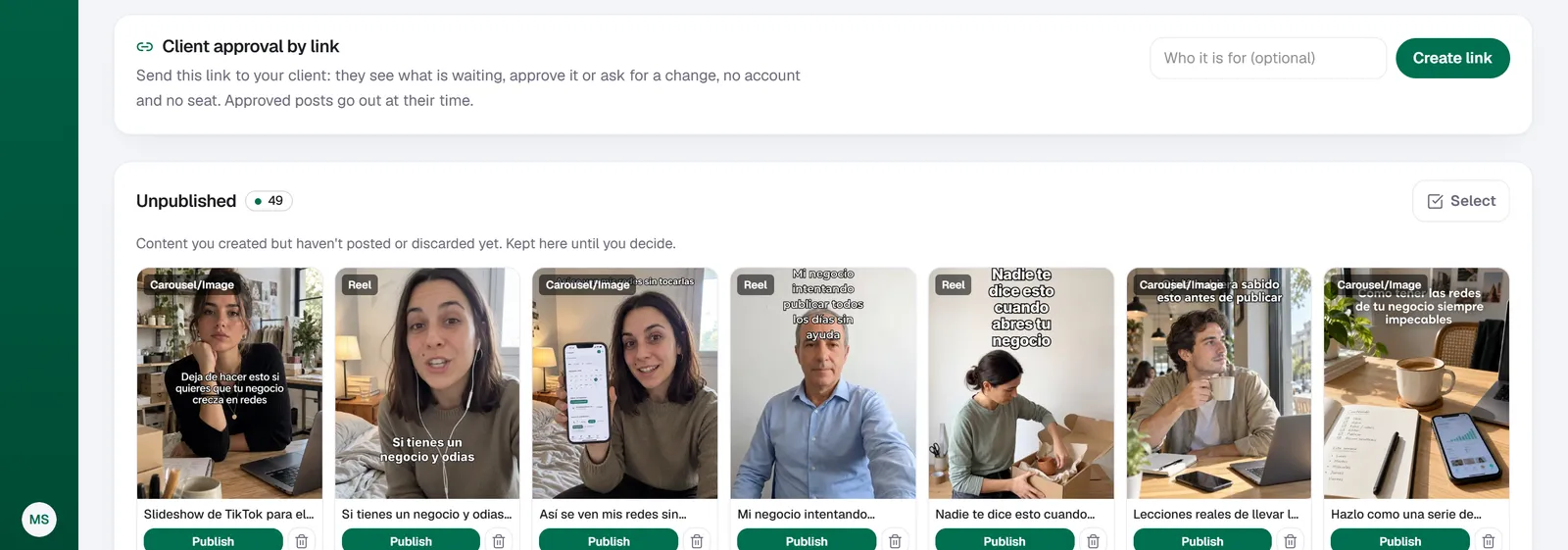
The approval queue in Quetzal: a client approves a post or asks for a change through a link, with no account and no seat, and underneath sits everything created but not yet published.
How white label social media content production works
The white label production pipeline converts raw client brand parameters into platform-ready assets that look entirely custom-built. In a traditional service setup, an agency acts as the account layer: the agency manages client communications, strategy, and billing, while the white label partner executes the actual asset generation behind an invisible wall.
An effective white label content pipeline follows five distinct stages:
- Brand ingestion: The agency establishes a distinct client profile containing visual assets (hex codes, typography rules, logos, visual style rules) and editorial requirements (tone of voice, forbidden terms, industry positioning, target audiences).
- Asset generation: The production engine builds multi-format posts based on current marketing goals. This includes designing static carousels, short-form video reels, infographics, and drafting network-specific captions with targeted hashtags.
- Internal quality assurance: The agency account manager reviews the output inside an unbranded or agency-branded environment to ensure compliance with the client brief before the client ever sees it.
- Client approval: Depending on the service agreement, the client reviews and approves posts through a white-labeled portal, or the agency operates on standing guidelines where content publishes automatically unless revised.
- Multi-platform publishing and measurement: Scheduled assets distribute to connected accounts across platforms such as Instagram, Facebook, LinkedIn, TikTok, X, and YouTube. Post-performance data is collected to refine subsequent production cycles.
Full intellectual property transfer is critical in this workflow. Agencies must ensure their provider agreements transfer all copyright, commercial rights, and output ownership upon generation, granting clients unrestricted commercial use of all copy, static designs, and video elements.
Sourcing models: Human subcontractors versus automated production engines
Agencies sourcing white label social media deliverables generally choose between three operational paths: human white label agencies, freelance contractor networks, or dedicated AI production software. Each carries distinct trade-offs in margin structure, production latency, and editorial oversight.
+------------------------------------+--------------------------+---------------------------+-----------------------------------+
| Operational Factor                 | White Label Agency       | Freelance Network         | Dedicated AI Software Platform    |
+------------------------------------+--------------------------+---------------------------+-----------------------------------+
| Production turnaround              | 5 to 10 business days    | 3 to 7 business days      | Under 5 minutes                   |
| Monthly cost per client workspace  | High ($600 - $1,500)     | Variable ($400 - $900)    | Predictable ($79 - $229)          |
| Agency gross margin potential      | 30% to 50%               | 40% to 60%                | 75% to 90%                        |
| Visual consistency across batches  | Variable by assigned rep | Inconsistent across hires | Exact compliance to brand kit     |
| Multi-channel video capability     | Often an expensive addon | Requires video specialist | Built-in end-to-end rendering     |
+------------------------------------+--------------------------+---------------------------+-----------------------------------+
Human white label agencies provide skilled execution but introduce heavy operational overhead. When an agency pays $800 per month for outsourced content and bills the client $1,500, gross margins remain capped at roughly 47%.
More critically, communication delays between the client, agency account manager, and external subcontractor often extend routine revision cycles to several business days.
Freelance networks offer variable pricing but require constant administrative management. Account managers spend significant non-billable hours matching design briefs to individual freelancers, vetting portfolio quality, and resolving unaligned visual styles.
Dedicated software systems bypass these operational bottlenecks. Modern platforms ingest brand parameters once and produce comprehensive social calendars instantly, enabling account managers to handle broader client rosters without sacrificing visual quality.
Agencies evaluating these operational differences often review our breakdown of the best social media management tools for agencies in 2026 to determine which delivery model matches their staffing structure.
Maintaining visual identity across diverse client rosters
The primary reason white label partnerships fail is visual drift. When external contractors change or creative briefs are loosely interpreted, published posts begin to deviate from a client's established brand identity. Colors skew off-palette, secondary fonts creep into graphics, and generic stock photography displaces genuine product imagery.
To prevent visual drift, white label workflows must isolate assets into independent brand workspaces. Each workspace should store:
- Primary, secondary, and accent color palettes defined by exact hex codes.
- Primary header and body typography pairings, including custom web font files.
- Vector logo files in light, dark, and monochrome variations with clear exclusion zones.
- A persistent library of authentic brand imagery, product photography, and approved background textures.
- Negative styling rules that explicitly prohibit certain visual layouts, background treatments, or generic stock graphics.
Agencies can evaluate their client accounts for style alignment using the free brand consistency check tool, which audits profile consistency across networks.
Encoding these brand guidelines into an automated engine eliminates visual drift entirely. Quetzal, an AI social media autopilot built in Málaga, Spain, by two founders, solves this problem by structuring production around dedicated client workspaces.
The engine ingests a client's visual identity (logo, palette, fonts, product photos) alongside their editorial parameters to generate static posts, ads, carousels, infographics, and stories that strictly adhere to brand specifications.
Because content is natively authored in both English and Spanish, agencies serving international accounts can scale across regions without hiring separate bilingual copy teams.
Managing multi-format production and short-form video
In 2026, text-and-image posts alone are insufficient to sustain client engagement metrics. Organic reach algorithms heavily prioritize multi-slide carousels and vertical short-form video formats across Instagram Reels, TikTok, and YouTube Shorts.
For agencies, producing short-form video has historically represented the most labor-intensive component of white label delivery. Sourcing voice actors, writing punchy scripts, timing video cuts, and generating dynamic word-by-word subtitle animations typically requires specialized video editors charging premium rates.
An effective white label service pipeline must support end-to-end video assembly. This requires an engine capable of drafting platform-optimized scripts, generating clear AI voiceovers, synchronizing animated captions to spoken words, and rendering edited vertical video files ready for direct dispatch.
Integrating automated video workflows into client retainers enables agencies to position themselves as modern growth partners rather than traditional static-post schedulers. For a deeper look at structural agency workflows, read our analysis on social media management software for agencies in 2026.
Structuring agency pricing, retainers, and profit margins
Delivering white label social media content is fundamentally an exercise in margin optimization. Agency retainers for full-service organic social media management generally fall into three tiers:
- Starter Retainers ($1,200 to $2,000/month): 3 to 4 static or carousel posts per week across 2 channels, basic scheduling, and monthly performance reporting.
- Growth Retainers ($2,500 to $4,500/month): Daily multi-network publishing across 4 to 5 platforms, including a mix of carousels, educational infographics, short-form reels, and weekly performance reviews.
- Full-Funnel Omnichannel Retainers ($5,000+/month): Daily publishing across 6 platforms, including vertical short-form video, active audience testing, ad creative variants, and dynamic content adjustments based on performance analytics.
When an agency relies on manual human outsourcing, production costs consume between 40% and 60% of these retainers. Shifting to an automated white label engine compresses delivery costs down to a fraction of that amount.
Quetzal structures pricing specifically to maintain high agency margins.
Plans are priced transparently: Starter at 79 EUR ($89 USD outside Europe), Growth at 199 EUR ($229 USD), Pro at 449 EUR ($499 USD), and Ultra at 899 EUR ($999 USD) per month billed annually, with a 7-day free trial, card required, nothing charged today.
Through our software platform for marketing agencies, teams run independent workspaces for each client on their roster, unlocking portfolio discounts starting from their third client.
This cost structure keeps raw production expenses below 10% to 15% of the client retainer, leaving the remaining budget for strategic advisory, campaign oversight, and firm profit.
Quality control, autopilot publishing, and performance tracking
Scaling an agency roster requires rigorous quality control systems that do not create administrative bottlenecks. Agencies managing white label content generally implement one of two approval configurations:
Supervised approval mode
Under this model, the software engine builds the upcoming week or month of content in batch drafts. The agency account manager reviews the captions, visual slides, and scheduled publish dates inside the workspace.
Once verified, the posts are either shared with the client via an external review link or scheduled directly. This model is ideal for newly acquired clients, heavily regulated industries (such as financial services or healthcare), or enterprise brands with strict corporate communications policies.
Autonomous autopilot mode
Once an agency establishes client confidence and refines brand guidelines, accounts can transition to an autonomous publishing posture. The platform continuously creates, designs, schedules, and publishes content directly to Instagram, Facebook, LinkedIn, TikTok, X, and YouTube under standing brand parameters without requiring manual approval for every single update.
To ensure continuous improvement under autopilot, performance tracking must close the loop between publishing and generation. Rather than relying on simple aggregate monthly vanity metrics, systems should inspect individual post engagement at fixed intervals.
Quetzal, for example, measures every published post at 1, 6, 24, and 72 hours. These precise measurement checkpoints show how immediate algorithm distribution translates into extended engagement lifecycles.
The system uses these data points to optimize subsequent production cycles, favoring formats, topics, visual styles, and posting windows that demonstrably perform best for that specific brand. To understand how to structure these systems across an agency team, consult our guide to choosing a social media automation agency workflow.
See how white label content looks on your clients' domains
Testing an automated white label workflow should not require manual creative labor or complex onboarding. Quetzal does the actual production work instead of merely scheduling, generating designed static posts, carousels, stories, captions, and complete AI video reels for client accounts.
All content uses the business's own logo, palette, fonts, and product photos so deliverables match brand guidelines rather than looking like templates.
In addition, the engine measures every post at 1, 6, 24, and 72 hours, using real engagement data to improve the next week's assets while letting agencies choose between full autopilot or per-post approval.
You can see how a full week of branded content looks for any client domain in about 3 minutes with no signup at /demo.
Frequently asked questions
Who owns the commercial copyright to white label social media content?
In standard white label software arrangements, the agency and its clients retain 100% of the commercial rights and intellectual property for all generated assets. This includes all static graphic designs, written captions, carousel sequences, and rendered short-form videos.
Agencies should ensure their client service agreements clearly state that intellectual property transfers automatically upon delivery or invoice settlement.
Can white label social media software publish natively to all major networks?
Modern white label engines connect directly to platform developer APIs to publish content natively without requiring third-party webhook relays or mobile push notifications. Production platforms can automatically format, schedule, and publish assets across Instagram (feed, stories, carousels, reels), Facebook, LinkedIn (company and personal profiles), TikTok, X, and YouTube (Shorts).
How do agencies prevent white label content from sounding generic?
Generic copy occurs when production tools lack context regarding a client's positioning, industry terminology, and target audience. Agencies prevent this by configuring granular workspace rules, defining precise brand tone, specifying approved and restricted terminology, and supplying reference materials such as case studies or product documentation.
Advanced platforms use these parameters to author contextually aware posts that reflect the brand's unique industry perspective.
Really made with Quetzal
Real product output, untouched. What you see is what it generates.