Guide · September 11, 2026
Social Media Content Approval Process: The 2026 Guide
Build an efficient social media content approval process in 2026. Compare workflow models, eliminate review bottlenecks, and automate brand sign-offs.
 By Jaime · Co-founder of Quetzal

A social media content approval process is a structured workflow where marketing teams, compliance officers, and external stakeholders review, edit, and sign off on social posts before publication. It establishes formal verification steps for copy, creative assets, and scheduling, preventing off-brand messaging, factual errors, and unauthorized publications from reaching public channels.
Quetzal streamlines this process by letting teams choose whether autopilot publishes autonomously under standing brand guidelines or pauses for per-post approval before anything goes live.
Because it creates posts, carousels, stories, and captions in your own visual identity, reviewers sign off on finished creative rather than assembling drafts across different tools. You can try it free on your own website to see how ready-to-approve content looks in minutes.
Without a standardized process, content distribution inevitably breaks down. Teams face missed deadlines, conflicting edits across fragmented chat threads, and slow sign-offs that cause timely social posts to lose relevance.
In highly regulated sectors or multi-client agencies, the lack of an auditable approval trail can also introduce substantial legal, copyright, and compliance liabilities.
Building a dependable review framework requires selecting the correct workflow structure, defining clear roles for every reviewer, and eliminating manual handoffs between production and scheduling tools.
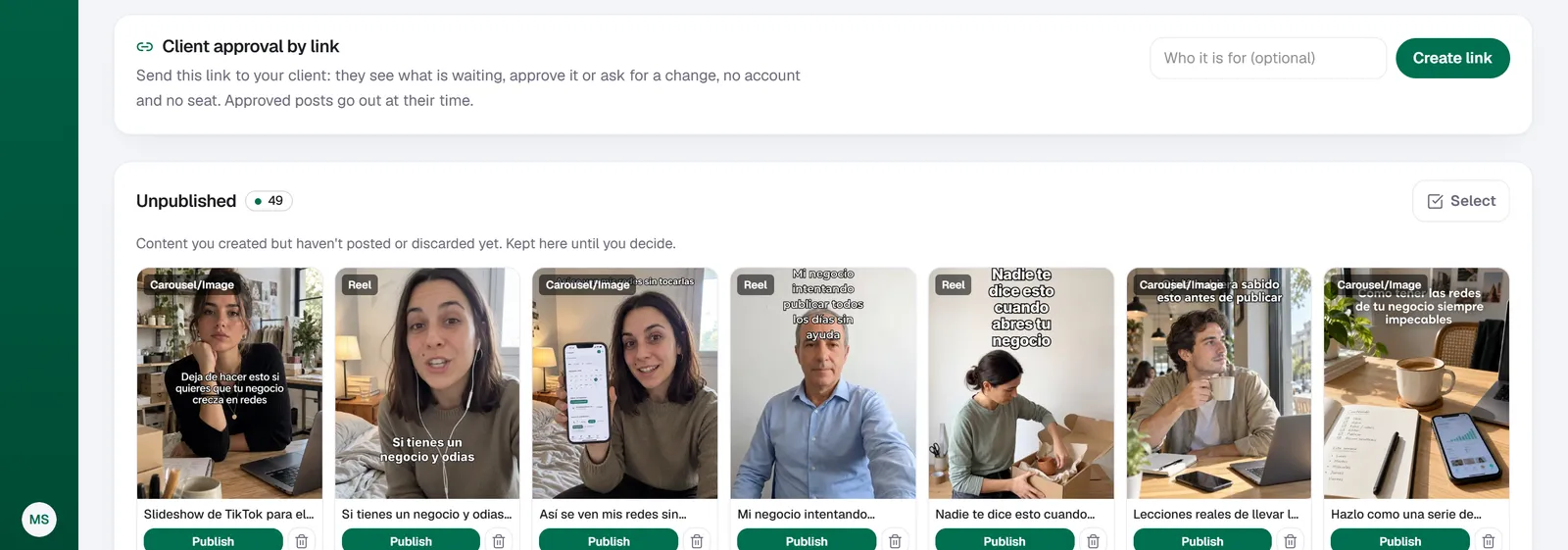
The approval queue in Quetzal: a client approves a post or asks for a change through a link, with no account and no seat, and underneath sits everything created but not yet published.
The five stages of a modern approval pipeline
A reliable approval pipeline coordinates creative production with business oversight. Rather than treating review as an ad hoc check immediately before publishing, modern marketing operations organize the workflow into five distinct, sequential phases.
1. Planning and conceptual sign-off
Approval begins before designers open visual editors or writers draft copy. In this phase, marketing strategists or campaign leads approve the monthly theme, core messaging pillars, and publishing cadence. Locking in themes early prevents creative teams from spending hours designing assets around angles that stakeholders subsequently reject.
2. Asset production and draft staging
Writers, graphic designers, and video producers generate the campaign assets against the approved brief. Instead of sending raw PNG files and text snippets through email, creators stage the content inside a central system that simulates the exact user interface of each target network.
Staging text alongside visuals in a realistic preview is essential, as line breaks, text cropping, and thumbnail safe zones behave differently across Instagram, TikTok, LinkedIn, and YouTube.
3. Peer and editorial review
Before sending posts to external clients or senior executives, an internal editor reviews the drafts. This stage focuses on mechanical quality:
- Spelling, grammar, and tone of voice.
- Correct tagging of accounts, hashtags, and UTM parameters.
- Image resolutions, video frame rates, and safe-zone clearances for mobile feeds.
- Compliance with brand typography, palettes, and logo usage rules.
4. Stakeholder or client sign-off
The designated business owner reviews the staged posts. In an in-house marketing department, this reviewer might be the product marketing director, legal counsel, or brand guardian.
In an agency setting, this is the client-side brand manager. The reviewer either approves the post as staged or requests specific revisions directly on the asset canvas.
5. Automated publishing and post-launch auditing
Once the final stakeholder signs off, the post enters a locked scheduling queue. No team member can make further edits without resetting the approval status, ensuring published posts match the approved versions precisely.
After publication, the operations team monitors real-time user engagement and platform indexing to confirm the asset published correctly.
The four structural models of social media sign-off
Organizations manage approval workflows differently depending on team size, regulatory overhead, and whether content is managed internally or by an outside agency. Choosing the wrong model either creates unnecessary administrative delays or exposes the organization to public errors.
To understand how teams formalize these tiers, consider the approval capabilities outlined in Planable pricing, which structures platform access around four distinct review models:
| Workflow Model | Review Mechanism | Ideal Team Structure | Software Tier Requirement |
|---|---|---|---|
| None | Direct publishing with zero approval gates | Solo creators and single-operator businesses | Free or entry-level plans |
| Optional | Open feedback; posts schedule without mandatory sign-off | Small in-house teams with flat hierarchies | Basic tier ($11/user/month billed annually) |
| Required | Hard gate; one designated reviewer must approve before scheduling | Growing brands, small marketing agencies | Pro tier ($22/user/month billed annually) |
| Multi-level | Sequential sign-off across multiple internal and external parties | Regulated enterprises, multi-tiered agency partnerships | Pro tier ($22/user/month billed annually) |
Source: Planable pricing, 2026.
None (direct publishing)
In this model, the person who produces the post has direct publishing permissions. While common for sole proprietors, it introduces substantial risk in teams of two or more, as no secondary check exists to catch typos, broken links, or expired promotional offers.
Optional approval
Optional approval allows team members to comment on and suggest edits to drafts, but does not block publishing. If a manager does not review a scheduled post by the publication date, the software publishes it automatically. This model suits agile, high-trust teams that prioritize velocity over strict editorial control.
Required approval
Required approval establishes a mandatory gatekeeper. A post cannot enter the publishing queue until a specific user clicks an explicit approval button. If the reviewer requests changes, the post returns to a draft state and cannot publish until re-reviewed. This model represents the baseline standard for brand safety.
Multi-level approval
Multi-level approval enforces sequential sign-offs across distinct functional departments. For example, a pharmaceutical brand or financial services firm may require sign-off from a copy editor, followed by a product specialist, followed by legal compliance.
If any single reviewer rejects the post, it pauses the workflow. Content only publishes after every level records an explicit approval.
Agency versus in-house approval workflows
While in-house teams and external marketing agencies both rely on approval workflows, their operational incentives differ significantly. Understanding these operational differences prevents communication breakdowns between agency partners and client teams.
In-house workflow dynamics
In-house teams typically face cross-departmental approval bottlenecks. A social media manager might need sign-off from product marketing to confirm feature naming, legal to check regulatory disclaimers, and human resources for employee spotlight features.
Because internal reviewers often view social media approvals as secondary to their primary job responsibilities, social media managers struggle with review lag. To solve this, in-house teams need rigid Service Level Agreements (SLAs), such as a policy where posts submitted 48 hours in advance are considered approved if internal departments raise no objections within 24 hours.
Agency-client workflow dynamics
For marketing agencies, approval workflows are directly linked to client retention and contract scope. Reviewing content across dozens of accounts simultaneously introduces unique friction points:
- Clients missing review deadlines, causing publishing calendars to pause.
- Multiple client stakeholders giving contradictory feedback inside comment threads.
- Scope creep, where clients request line-by-line copy rewrites during late-stage visual reviews.
Agencies avoid these friction points by establishing single-point-of-contact rules. The client designates one primary reviewer whose decisions are final.
Furthermore, modern agencies separate workspace permissions so clients can view and approve their own content calendars without seeing internal agency discussions, draft iterations, or other client rosters.
For a deeper look at how modern service providers run scalable production pipelines across client rosters, read our guide on what an AI social media agency does.
Shifting from manual production to automated review queues
The traditional approval workflow was designed around manual human production: a copywriter wrote text in a document, a designer assembled graphics in an editing tool, a social media manager copy-pasted both into a scheduler, and an executive reviewed the result. This assembly line is slow, fragmented, and vulnerable to simple copy-paste errors.
In 2026, marketing organizations are shifting to generative, exception-based approval workflows. Instead of manually creating drafts and asking stakeholders to review every asset from scratch, teams use systems that generate production-ready drafts matching predefined brand identities automatically.
Under an exception-based approval model, human reviewers do not micromanage basic formatting, font sizes, or baseline caption structures. Instead, they act as high-level editors who review automatically generated campaigns, stepping in only to make contextual tweaks or approve the batch for distribution.
To explore the mechanics behind these production systems, see our technical breakdown of AI social media content generators.
This shift changes the role of the social media manager. As detailed in our breakdown of the AI social media manager role, human teams spend less time shuffling files between review apps and more time establishing the standing guidelines that govern autonomous generation.
Traditional Approval Workflow:
[Brief] -> [Copywriter] -> [Designer] -> [Manager Review] -> [Client Review] -> [Manual Scheduling]
(Average cycle time: 5-8 business days)

Exception-Based Approval Workflow:
[Brand Rules Engine] -> [Autonomous Generation] -> [Unified Review Queue] -> [Automated Publishing]
(Average cycle time: 10-15 minutes per batch)
Quetzal was engineered specifically to support this modern operational model. Built in Málaga, Spain, by two founders, Quetzal is an AI social media autopilot that generates designed static posts, ads, carousels, infographics, stories, and captions inside your brand's existing visual identity.
By reading your official color palettes, typography, logos, and product assets, it builds fully rendered, platform-ready creative automatically.
Quetzal also generates AI video reels end to end: script, AI voiceover, word-synced captions, and a finished edited render, published like any other post.
Crucially for governance, Quetzal does not force teams into a single operational pattern. The customer chooses whether the autopilot runs fully autonomously under standing brand guidelines, or pauses every asset inside a per-post approval queue before scheduling and publishing across Instagram, Facebook, LinkedIn, TikTok, X, and YouTube.
Once published, Quetzal measures performance at 1, 6, 24, and 72 hours, using audience engagement data to refine the visual layouts, hooks, and topics generated for the following week.
For marketing agencies managing multiple brands, Quetzal structures these review flows through isolated workspaces, running one workspace per client with portfolio discounts unlocked starting from the third client.
A production checklist for social media approvals
Whether you use an automated review queue or review drafts manually, your review team should evaluate every piece of content against a standardized scorecard. Using an objective checklist eliminates subjective disagreements and keeps review cycles fast.
1. Visual identity and asset framing
- Does the visual use the exact hexadecimal brand colors rather than arbitrary tints?
- Are the primary fonts and font weights compliant with typography guidelines?
- Is the company logo positioned outside of the interface overlays (such as TikTok audio descriptions, Instagram Reels action buttons, or LinkedIn mobile navigation)?
- If the post uses video, are the word-synced subtitles legible against light backgrounds, and does the audio mix keep voiceovers audible over background music?
- You can verify your live profile consistency using our free brand consistency audit tool.
2. Copy and contextual messaging
- Is the core hook relevant to the target audience segment?
- Are all URLs configured with accurate UTM tags to ensure proper web analytics attribution?
- Are pricing figures, promotional discount codes, and expiration dates factually accurate?
- Does the caption include a clear, singular call to action rather than competing requests?
3. Compliance and governance
- Are all necessary regulatory, legal, and copyright disclaimers present and legible?
- Does the post credit external creators, partner accounts, or user-generated content owners properly?
- Does the publication date avoid sensitive public events, holidays, or company quiet periods?
Test your approval workflow with automated brand drafts
Testing an approval process works best when reviewing real creative rather than empty templates. First, Quetzal does the creative heavy lifting instead of just organizing files, generating static posts, carousels, captions, and full video reels end to end.
Second, teams keep complete control by choosing between autonomous publishing under standing guidelines or mandatory per-post approval before anything goes live across six platforms. Third, every asset arrives pre-formatted in your visual identity with your own logo, palette, fonts, and product photos.
You can test this workflow on your own business with a week of branded content created in about 3 minutes at /demo.
FAQ
Who should be included in a social media approval process?
An effective approval workflow includes an asset creator, an editorial reviewer for quality control, and a designated business stakeholder who owns final sign-off. Highly regulated businesses, such as healthcare or financial services organizations, must also include legal or compliance officers in a formal sequential tier.
Keep the total number of decision-makers as small as possible to prevent review deadlocks.
How many approval stages should a small team use?
Small teams should use a single-stage required approval workflow. In this setup, the content creator stages the post, and a single brand lead or marketing manager conducts the final review and approves it for scheduling. Introducing multi-tier approvals to a small team creates unnecessary administrative overhead without significantly lowering publishing risk.
What is the difference between sequential and parallel approvals?
Sequential approval requires reviewers to sign off in a rigid, predetermined order; a post only advances to the next stakeholder after the previous reviewer approves it. Parallel approval sends the post to all reviewers simultaneously, allowing stakeholders to review, leave feedback, and approve concurrently.
Sequential models offer stronger compliance guarantees, while parallel models reduce total turnaround time.
Can social media approval processes be fully automated?
Yes, businesses can automate approvals by defining clear brand rules, visual templates, and negative keyword boundaries within automated publishing software. Platforms like Quetzal allow teams to run fully autonomously under standing brand guidelines or require human sign-off on a per-post basis.
Many organizations begin with per-post human approval and switch to autonomous publishing once they verify that generated assets consistently match brand standards.
Sources
- Planable pricing: https://planable.io/pricing/
Really made with Quetzal
Real product output, untouched. What you see is what it generates.