Guide · September 11, 2026
What an AI Social Media Manager Actually Does in 2026
An AI social media manager handles content design, video, scheduling, and analytics autonomously. Learn how modern AI managers work and what to expect.
 By Sergio · Co-founder of Quetzal

An AI social media manager is an automated software system that handles the complete operational lifecycle of social publishing: generating on-brand graphics and videos, writing copy, scheduling posts, publishing across networks via direct APIs, and analyzing post telemetry to refine future strategy.
Unlike isolated generative tools that require human direction for every prompt, an AI manager runs continuous production cycles aligned with a brand's visual and tonal guidelines.
In 2026, businesses and marketing agencies deploy these systems either as fully autonomous publishing engines or as collaborative co-pilots operating under human approval.
Quetzal handles this operational lifecycle by generating finished posts, carousels, and end-to-end video reels in a brand's own visual identity rather than populating generic templates.
It publishes across six networks and measures engagement at 1, 6, 24, and 72 hours to continuously improve subsequent output, allowing you to try it free on your own website.
Teams can deploy the system on full autopilot or maintain editorial control by approving each post before publication.
To evaluate whether this software category fits your marketing operations, you need to understand how automated managers differ from standard scheduling dashboards, how they maintain brand identity across complex formats, and where human oversight remains necessary.
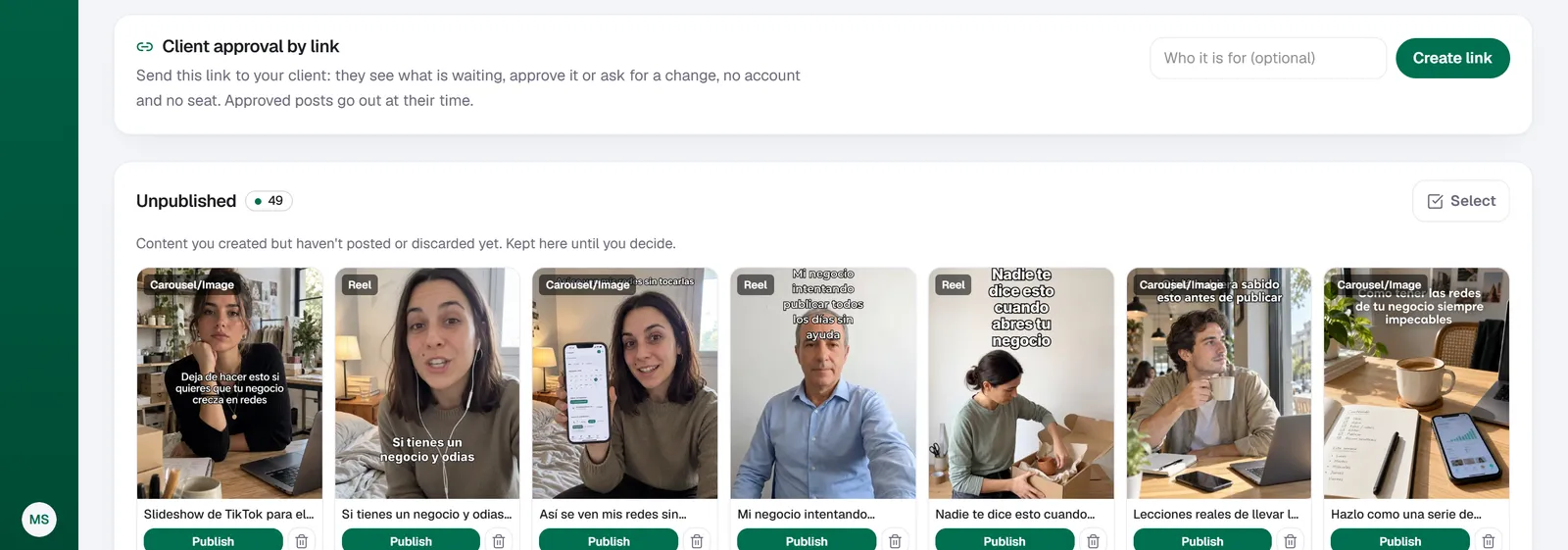
The approval queue in Quetzal: a client approves a post or asks for a change through a link, with no account and no seat, and underneath sits everything created but not yet published.
The difference between an AI tool and an AI social media manager
The social media software market contains hundreds of point solutions, but there is a clear boundary between an individual generative tool and a dedicated AI social media manager.
Generative point solutions solve single tasks in isolation. A marketing team might use a large language model to draft post captions, an image synthesis tool to create conceptual visuals, and an online design editor to arrange typography.
The human operator still carries the entire burden of integration:
- Copying text
- Uploading visual assets into separate scheduling tools like Buffer or Hootsuite
- Setting publication times
- Reviewing native analytics dashboards days later
If you want to review the fragmented landscape of single-task utilities, see our evaluation of the best AI social media tools.
By contrast, an AI social media manager acts as an end-to-end operations layer. It eliminates the manual handoffs between generation, production, distribution, and measurement.
The system does not ask you for prompts every morning; instead, it ingests standing brand assets, generates production-ready creative in your exact visual identity, posts directly to connected social accounts, and evaluates performance data.
Crucially, an AI manager incorporates a closed feedback loop. When a manual workflow publishes a post, performance insights often sit abandoned inside native platform analytics.
A true AI social media manager reads engagement signals at scheduled intervals and uses that empirical data to calibrate the topics, formats, and design styles produced for the following week.
Core capabilities of an autonomous social media manager
Executing social media management without daily human input requires four distinct technical capabilities working in synchronization.
1. Multi-format visual production
Social media platforms favor diverse media feeds. A viable system cannot rely purely on text updates or generic stock photography overlaid with text boxes. It must produce:
- Structured carousel slides formatted specifically for LinkedIn and Instagram
- Information-dense infographics that translate data into scannable layouts
- Platform-native static images, promotional ads, and transient story layouts
- Vertical short-form video formatted for algorithmic feeds
2. Native end-to-end video generation
Short-form vertical video (TikTok, Instagram Reels, and YouTube Shorts) is computationally harder to automate than static imagery. A comprehensive AI manager cannot stop at generating video scripts.
It must execute every phase of production:
- Write the script
- Synthesize a natural voiceover track
- Generate dynamic, word-synchronized captions
- Render an edited vertical video ready for automated distribution
3. Direct multi-platform publishing
An automated manager must interface directly with official developer APIs across major networks: Instagram, Facebook, LinkedIn, TikTok, X, and YouTube.
Without direct API integration, software relies on push notifications requiring a human to manually download media and upload it to the respective app, defeating the purpose of automation.
4. Telemetry-driven self-improvement
Automated publishing without analytical feedback is merely spam at scale.
A proper AI social media manager tracks every published post across distinct operational windows: typically at 1 hour, 6 hours, 24 hours, and 72 hours post-publication.
These measurement intervals track velocity and longevity, feeding audience retention and engagement metrics directly back into the creative engine to refine subsequent production runs.
Maintaining brand identity without generic templates
The primary failure mode of early generative marketing software was stylistic drift. Off-the-shelf generative models tend to produce recognizable, hyper-saturated graphics or generic, conversational prose littered with repetitive corporate jargon.
Modern AI social media managers solve this through deterministic style constraints. Built in Málaga, Spain, by two founders, Quetzal approaches this problem by enforcing rigid visual guardrails rather than asking an image model to invent layouts from scratch.
Instead of outputting generic stock compositions, the engine extracts and locks a business's exact color palette, typographic pairings, and official vector logos.
When static posts, carousels, or infographics are generated, your actual product photography and brand assets are dynamically merged into structured layouts designed specifically for conversion.
This ensures that content published on day thirty carries the exact same visual identity and brand weight as content published on day one.
The same discipline applies to linguistic identity. High-performing social media copy requires cultural resonance and idiomatic accuracy.
Quetzal authors content natively in both English and Spanish, avoiding the awkward syntax common in platforms that write in English and rely on secondary machine translation layers.
You can explore the technical architecture behind these multi-format generation workflows on the Quetzal product overview page.
Comparing manual teams, scheduling tools, and AI managers
To understand where an AI social media manager sits within the broader marketing ecosystem, consider how it compares to conventional social management methods across key operational categories.
| Operational Function | In-House Staff or Freelancer | Traditional Scheduler (Buffer, Later) | Modern AI Social Media Manager |
|---|---|---|---|
| Asset Creation | Manual design in Figma, Canva, or Adobe suite | None (requires human to upload finished assets) | Automated generation of carousels, static designs, and ads |
| Short-Form Video | Manual filming, scriptwriting, voice recording, editing | None (manual upload only) | End-to-end generation: script, AI voiceover, captions, render |
| Copywriting | Manual drafting per channel | Manual drafting, occasionally assisted by basic prompt boxes | Native generation adapted to specific channel conventions |
| Publishing | Manual or scheduled via third-party tools | Automated publishing via API queues | Fully automated publishing across 6 major networks |
| Feedback Loop | Manual reporting; periodic human review | Static analytical graphs without production integration | Post telemetry measured at 1, 6, 24, 72 hours to direct new posts |
| Turnaround Time | Days to weeks per content batch | Dependent entirely on human input speed | Complete weekly multi-channel schedule in minutes |
| Operational Focus | High cognitive overhead; variable consistency | Distribution utility only; zero creative generation | Systemic consistency, automated production, operational scale |
Approval workflows: fully autonomous versus human-in-the-loop
Deploying an AI social media manager does not mean surrendering editorial oversight. Organizations operate with varying risk tolerances and compliance requirements, which makes workflow flexibility essential.
There are two primary operating models for an AI social media manager:
Staging with per-post approval
In this configuration, the AI acts as an automated production studio.
At the start of a production cycle, the system generates the upcoming week or month of content across all formats: complete with visuals, render-ready video reels, captions, and publication times.
Internal marketing leaders or agency account managers log in, review the proposed queue, make textual adjustments, swap imagery if desired, and approve the queue.
Nothing goes live without explicit human sign-off.
This model preserves human editorial standards while eliminating roughly 80 percent of the time spent on manual drafting and asset assembly.
Autonomous autopilot
For organizations prioritizing speed and consistent output over granular line-editing, the manager operates under standing brand guidelines.
The business connects its accounts, establishes core thematic topics and cadence, and lets the system handle generation, scheduling, publication, and real-time analytical adjustment autonomously.
Autopilot allows lean teams to maintain an active, professional presence across networks that would otherwise require dedicated full-time hires or expensive outsourced retainers.
The agency operating model
Marketing agencies face distinct challenges: managing dozens of client brands simultaneously without diluting quality or eroding margins. Rather than replacing account executives, agencies utilize automated managers to handle baseline content production.
In Quetzal, agency teams set up an independent workspace for each client to keep brand assets, historical data, and publishing queues strictly segregated.
This multi-workspace architecture allows agencies to scale their roster sustainably, leveraging portfolio discounts available starting from the third client.
For a detailed breakdown of this operational structure, read our guide to white label social media management.
The economics of AI management for businesses and agencies
Social media management has traditionally been expensive because it requires multiple specialized disciplines:
- A copywriter
- A graphic designer
- A video editor
- A community or campaign manager
Hiring a full-time in-house specialist involves substantial baseline salary overhead, benefits, and software subscriptions.
Engaging a traditional digital marketing agency typically incurs retainers ranging between 1,500 and 5,000 EUR or USD per month per client, driven largely by the manual hours required to design graphics and edit video.
An AI social media manager alters this cost equation by compressing the production pipeline into software. For businesses operating independently, Quetzal offers transparent self-serve pricing:
- Starter: 79 EUR per month billed annually (or $89 USD outside Europe)
- Growth: 199 EUR per month billed annually (or $229 USD outside Europe)
- Pro: 449 EUR per month billed annually (or $499 USD outside Europe)
- Ultra: 899 EUR per month billed annually (or $999 USD outside Europe)
Every tier includes a 7-day free trial that does not require a credit card to begin. Full feature breakdowns across tiers are available on the Quetzal pricing page.
For an agency or a growing business across the United States, Spain, or the rest of Europe, shifting baseline creative production to automated software preserves cash flow while guaranteeing that social channels receive consistent, high-fidelity media every week.
Test an AI social media manager on your own website
Instead of acting as a passive scheduling tool that simply organizes content you have already created, Quetzal does the actual production work by generating posts, carousels, captions, and end-to-end video reels.
Every asset uses your company's own logo, color palette, fonts, and product photos, ensuring social feeds reflect your authentic brand identity rather than generic templates.
The engine then publishes across six networks and gets better every week by measuring performance at 1, 6, 24, and 72 hours to direct upcoming schedules.
To generate a real week of branded content from your website in about 3 minutes without signing up, visit the Quetzal demo.
Frequently asked questions
Can an AI social media manager completely replace a human marketing team?
An AI social media manager replaces the manual production and operational overhead of social media: drafting captions, laying out graphic assets, editing vertical video clips, scheduling posts, and pulling performance metrics.
However, it does not replace high-level business strategy, physical event coverage, active community relationship building, or real-time customer service.
The most effective implementations use the AI to handle continuous baseline publishing, freeing human marketers to focus on strategic partnerships, product messaging, and direct audience engagement.
How does an AI manager preserve visual consistency across different post formats?
High-performing systems do not rely on open-ended text-to-image prompting for production work, as this introduces visual drift.
Instead, an AI manager extracts fixed brand constraints:
- Primary and secondary hex colors
- Approved typography
- Vector logos
- Authentic product assets
It then maps dynamic text, synthesized infographics, and curated imagery into structured layout frameworks built specifically for social formats, ensuring that every asset aligns with your brand standards.
Do social media algorithms penalize content published by automated AI managers?
No. Major platforms like Instagram, LinkedIn, TikTok, Facebook, X, and YouTube provide official developer APIs specifically designed for third-party publishing platforms.
Algorithms evaluate content based on audience engagement signals: watch time, swipe-through rates, shares, saves, and comments.
The algorithm does not penalize whether an asset was scheduled via an API or uploaded manually; it prioritizes whether the media captures and holds audience attention.
Continuous measurement systems help ensure that content improves based on those exact engagement metrics.