Guide · September 11, 2026
What Is an AI Social Media Agency? The 2026 Guide
Learn what an AI social media agency does in 2026, how automated workflows compare to traditional retainers, and how to scale multi-platform publishing.
 By Sergio · Co-founder of Quetzal

An AI social media agency is an agency or technology partner that uses artificial intelligence pipelines to automate the creation, scheduling, publishing, and optimization of social content.
Instead of billing clients for hours spent manually writing captions, adjusting visual templates, or editing short-form video clips, an AI agency operates an automated production system that outputs brand-aligned assets across multiple networks.
For many businesses, modern autonomous social media platforms can perform this work directly, offering the output of a creative agency without the overhead of human retainers.
Quetzal handles this entire production cycle as an AI social media autopilot, generating designed static posts, ads, carousels, captions, and complete video reels in a business's own visual identity.
It publishes directly across six networks and adapts each post based on ongoing performance tracking, and anyone can try it free on your own website in about 3 minutes without signing up.
Understanding the mechanics of an AI social media agency helps you evaluate whether to hire an external service provider, adopt agency-grade tools within your existing team, or replace agency services entirely with an autonomous platform.
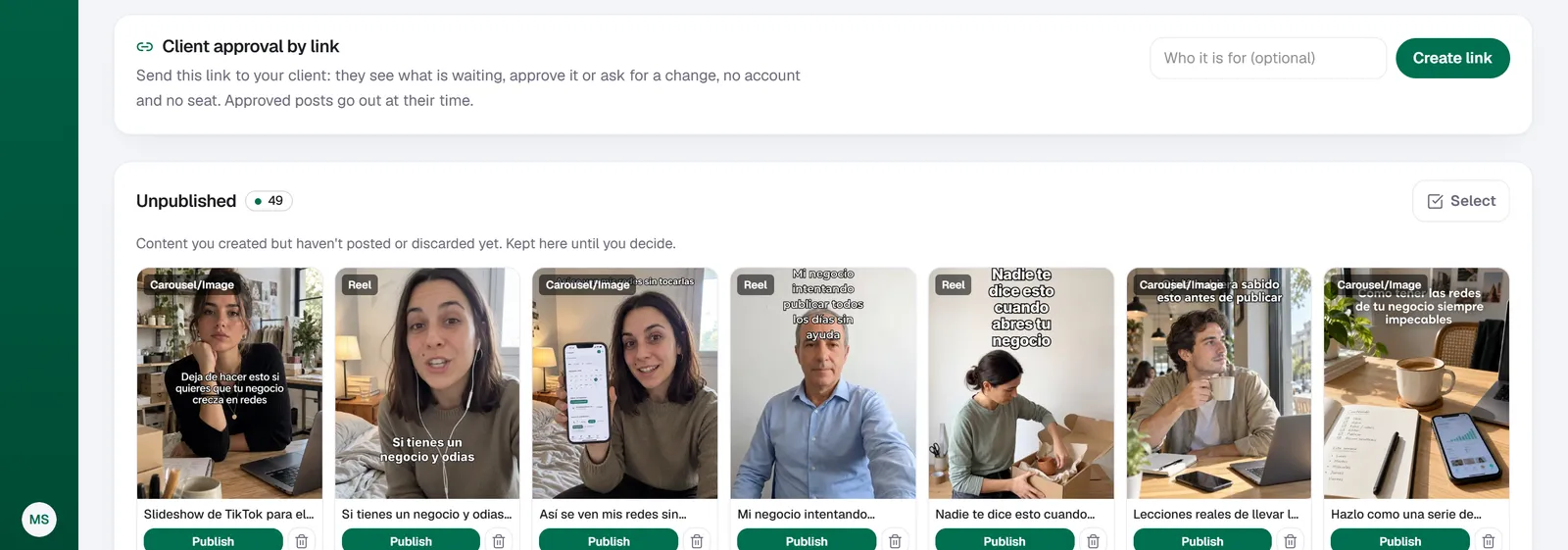
The approval queue in Quetzal: a client approves a post or asks for a change through a link, with no account and no seat, and underneath sits everything created but not yet published.
What an AI social media agency actually is in 2026
The traditional marketing agency model relies heavily on manual labor. Account managers coordinate with copywriters, graphic designers, video editors, and media planners to produce a monthly content calendar. This workflow requires substantial human coordination, leading to high agency retainers, slow revision turnarounds, and creative bottlenecks.
An AI social media agency replaces the manual production assembly line with interconnected software models. Rather than starting from a blank canvas for each campaign, the agency defines a brand identity framework: color palettes, typography, tone of voice, product imagery, and target audience segments.
Once established, generative systems produce finished creative assets that match those exact parameters.
In 2026, an agency using an advanced AI social media content generator no longer limits its production to text captions or generic stock images. Modern pipelines generate designed static posts, promotional ads, multi-slide carousels, data-driven infographics, interactive stories, and vertical video reels with native voiceovers and kinetic captions.
The primary deliverable of an AI social media agency is not human billable hours; it is a continuously publishing content engine that improves its output based on real-time engagement metrics.
Traditional agencies versus AI agencies versus autonomous software
Before deciding how to manage your brand presence, it helps to understand how traditional creative agencies, AI-assisted agencies, and autonomous software platforms differ across pricing, speed, and operational control.
| Operational Factor | Traditional Creative Agency | AI-Powered Agency | Autonomous Software Platform |
|---|---|---|---|
| Typical Monthly Cost | $2,500 to $10,000+ per month | $1,000 to $3,500 per month | $89 to $499 per month |
| Asset Turnaround Time | 2 to 4 weeks per calendar | 2 to 3 days per calendar | Minutes on demand |
| Video Reel Production | Requires camera crews and editors | AI-assisted script and assembly | Automated script, voiceover, and render |
| Publishing Model | Manual upload via legacy schedulers | Semi-automated scheduling | Direct API autopilot across 6 networks |
| Performance Adaptation | Monthly or quarterly reviews | Weekly reporting reviews | Feedback at 1, 6, 24, and 72 hours |
| Brand Governance | Human account manager oversight | Prompt engineering and brand decks | Hard visual identity constraints |
Traditional agencies excel when a company requires bespoke, on-location physical video shoots or high-touch public relations management. However, for continuous social presence, daily audience nurturing, and multi-platform visibility, an autonomous software platform delivers comparable creative output at a fraction of the cost.
The core services delivered by an AI social media agency
An AI social media agency focuses on end-to-end execution. A modern automated pipeline encompasses five fundamental services.
1. Visual identity extraction and preservation
The primary failure point of early generative marketing tools was visual inconsistency. A brand cannot publish neon typography one day and muted corporate design the next.
An AI agency configures software to enforce strict brand constraints. The system extracts the company logo, color hex codes, font families, and product photography directly from an existing website or style manual.
Every static post, ad, carousel, and infographic generated by the system adheres strictly to these parameters, ensuring that the brand identity remains consistent across every social channel. Brands can run their own profiles through a free brand consistency audit to see how cohesive their profiles appear before automating production.
2. End-to-end short-form video generation
Video reels drive organic distribution across Instagram, TikTok, YouTube Shorts, and Facebook. Producing video manually is historically expensive, requiring scriptwriting, voice recording, pacing, captioning, and video editing.
An AI-driven workflow handles the entire video creation sequence programmatically:
- Generating hook-driven scripts optimized for watch time.
- Producing natural AI voiceovers in multiple languages.
- Creating word-synced animated captions to capture silent viewers.
- Stitching relevant background assets, motion graphics, and audio tracks into a rendered vertical video.
The completed video is queued and published directly through the platform API without requiring manual editing software.
3. Multi-platform scheduling and distribution
Marketing across modern channels requires formatting native content for different audience expectations. The tone used on LinkedIn does not match the conversational style required for X or the visual pacing expected on Instagram and TikTok.
AI agencies utilize programmatic distribution across six primary platforms: Instagram, Facebook, LinkedIn, TikTok, X, and YouTube. Rather than copying and pasting identical content to every network, the system generates platform-appropriate captions, aspect ratios, and hashtags tailored to each specific network algorithm.
4. Continuous closed-loop optimization
Traditional agencies review analytics at the end of the month, compiling static PDF reports that arrive long after a campaign has run its course. An AI social media agency or autonomous tool operates an algorithmic feedback loop.
To see this workflow in practice, consider how Quetzal, an AI social media autopilot built in Málaga, Spain, by two founders, monitors post metrics. Quetzal measures performance signals at 1, 6, 24, and 72 hours after publication.
The system evaluates impressions, comments, shares, and watch retention across platforms, using those data points to update the creative prompts for the following week. Posts that yield strong engagement serve as templates for future topics, while underperforming concepts are automatically phased out.
5. Flexible governance and approval modes
Trust remains a critical consideration when deploying artificial intelligence in marketing. Reliable AI agency pipelines offer flexible operational modes:
- Per-post approval: The brand team reviews and approves each visual asset, caption, and scheduled time before the post goes live.
- Autonomous autopilot: The system generates, schedules, and publishes content automatically under pre-set brand guardrails, alerting administrators only if human intervention is required.
To understand the day-to-day mechanics of algorithmic posting, read our detailed guide on what an AI social media manager actually does in 2026.
How marketing agencies use AI software to run client rosters
For marketing agencies looking to modernize their services, adopting AI software transforms operational margins. Historically, an agency account manager could handle four to six client accounts before service quality declined. With an automated social media engine, a single account strategist can oversee dozens of brands simultaneously.
Agencies using modern platforms deploy dedicated workspaces for each client on their roster. This architecture isolates client assets, brand colors, custom logos, and connected social accounts.
Specialized platforms support agency scalability:
- Per-client workspaces: Every client profile remains distinct, preventing cross-brand contamination of visual identity or connected accounts.
- Portfolio discounts: When managing multiple brands, platforms like Quetzal provide tiered portfolio pricing starting from the third connected client workspace.
- Native multilingual authoring: Software natively authoring content in languages like English and Spanish allows regional agencies to scale international campaigns without hiring native copywriters for every market.
Agencies interested in streamlining production across multiple client accounts can explore Quetzal's dedicated software for marketing agencies to replace manual scheduling and visual design tasks with automated pipelines.
Cost breakdown: agency retainers compared to dedicated AI platforms
The financial rationale for shifting to an AI-driven workflow is clear. Traditional agency retainers are tied to hourly compensation, whereas software-led production scales with computing power.
Traditional agency fees
A boutique creative agency charging for multi-network management typically bills between $2,500 and $8,000 per month. This fee covers a set number of deliverables, such as twelve static posts and four simple video reels per month. Any request outside the agreed scope results in revision fees or higher hourly billings.
AI agency retainers
Agencies that position themselves as AI-native generally charge lower retainers, typically between $1,000 and $3,000 per month. They pass software efficiency gains on to the client while retaining a healthy margin for prompt curation, campaign strategy, and manual oversight.
Autonomous AI platform subscriptions
If a business chooses to operate AI software directly rather than paying an agency intermediary, the monthly expenditure drops substantially.
Quetzal provides direct software subscriptions for brands in Europe and the United States:
- Starter: €79 per month billed annually ($89/month in the United States).
- Growth: €199 per month billed annually ($229/month in the United States).
- Pro: €449 per month billed annually ($499/month in the United States).
- Ultra: €899 per month billed annually ($999/month in the United States).
All tiers include a 7-day free trial, card required, nothing charged today, allowing brands to test automated generation and multi-channel scheduling before making a financial commitment. To see how these tiers align with your operational volume, review Quetzal's plans and pricing.
How to choose between hiring an agency and deploying an AI autopilot
Choosing whether to hire an AI-powered agency or manage an autonomous AI platform internally depends on your internal bandwidth and content requirements.
                  Do you need live, on-location physical filming?
                                 /              \
                                /                \
                             YES                  NO
                             /                      \
             Hire a traditional agency        Do you have in-house
             with dedicated camera crews.     strategic direction?
                                              /                 \
                                             /                   \
                                          YES                     NO
                                          /                         \
                       Deploy an AI autopilot           Hire an AI agency
                       software directly.               for strategic management.
Deploying an autonomous software platform directly is the ideal path if:
- Your primary goal is consistent organic publishing across LinkedIn, Instagram, TikTok, Facebook, X, and YouTube.
- You already have product images, a functioning website, and clear visual branding guidelines.
- You want to eliminate long-term agency contracts, multi-week production delays, and high monthly retainers.
- You prefer maintaining direct administrative control over your social channels through an intuitive per-post approval dashboard.
Conversely, hiring an external AI agency makes sense if your team completely lacks the time to review generated assets, or if your overall growth strategy requires complex cross-channel media buying, influencer partnerships, and bespoke PR outreach.
See how an automated agency workflow looks for your brand
Instead of paying agency retainers, Quetzal generates designed static posts, carousels, stories, captions, and finished video reels in your brand's exact visual identity rather than generic templates.
It publishes across six networks and measures every post at 1, 6, 24, and 72 hours to improve future content, while letting you choose between full autopilot or per-post approval. Anyone can see a full week of branded content produced in about 3 minutes with no signup at /demo.
Frequently asked questions
Can an AI agency maintain strict brand guidelines?
Yes. Modern AI platforms do not rely on generic prompts that produce unpredictable visuals.
Instead, the software ingests a brand's specific color codes, typography, logos, and approved product imagery. Every generated static graphic, infographic, ad, and video render is constructed within these strict design rules to ensure complete brand consistency across all connected social channels.
What social media platforms can an AI agency automate?
Full-service AI social media pipelines automate publishing across six major networks: Instagram, Facebook, LinkedIn, TikTok, X, and YouTube. The underlying systems automatically format image aspect ratios, adapt caption lengths, generate channel-specific hashtags, and assemble vertical video reels tailored to the programmatic specifications of each network's API.
How does performance tracking feed back into content production?
Instead of generating static monthly reports, modern AI social platforms monitor every published post at specific time intervals, such as 1, 6, 24, and 72 hours after release. The system evaluates engagement signals, watch retention, and follower actions to determine which visual layouts, hooks, and content formats are resonating.
These insights are programmatically fed back into the content engine to improve the concepts, topics, and visual formats generated for subsequent weeks.