Guide · September 11, 2026
AI Social Media Content Generator: The 2026 Guide
Looking for an AI social media content generator? Learn how modern tools produce on-brand designs, captions, and video reels end to end in 2026.
 By Jaime · Co-founder of Quetzal

An AI social media content generator is software that automatically produces publication-ready marketing assets, including designed static graphics, multi-slide carousels, short-form video reels, and platform-specific captions.
Unlike basic text assistants that merely draft copy, modern content generators ingest your brand assets, apply design rules, write contextual editorial text, and package the final output for direct distribution. The goal is to eliminate the manual bottleneck between strategy and creative execution across multiple digital channels.
Quetzal addresses this bottleneck by taking over the actual creative production rather than just organizing schedules. It creates publication-ready static posts, multi-slide carousels, and video reels formatted for six platforms in your brand's own palette, fonts, and visual identity, which you can try free on your own website.
Teams can choose to let the system run on full autopilot or approve each asset individually before it goes live.
As distribution demands have scaled, social media teams have found that drafting text prompts is only a fraction of the actual workload. Production stalls on visual assembly, resizing, video subtitles, voiceover syncing, and platform formatting.
Understanding how the current generation of tools approaches these problems helps marketing teams separate simple text wrappers from integrated creative engines.
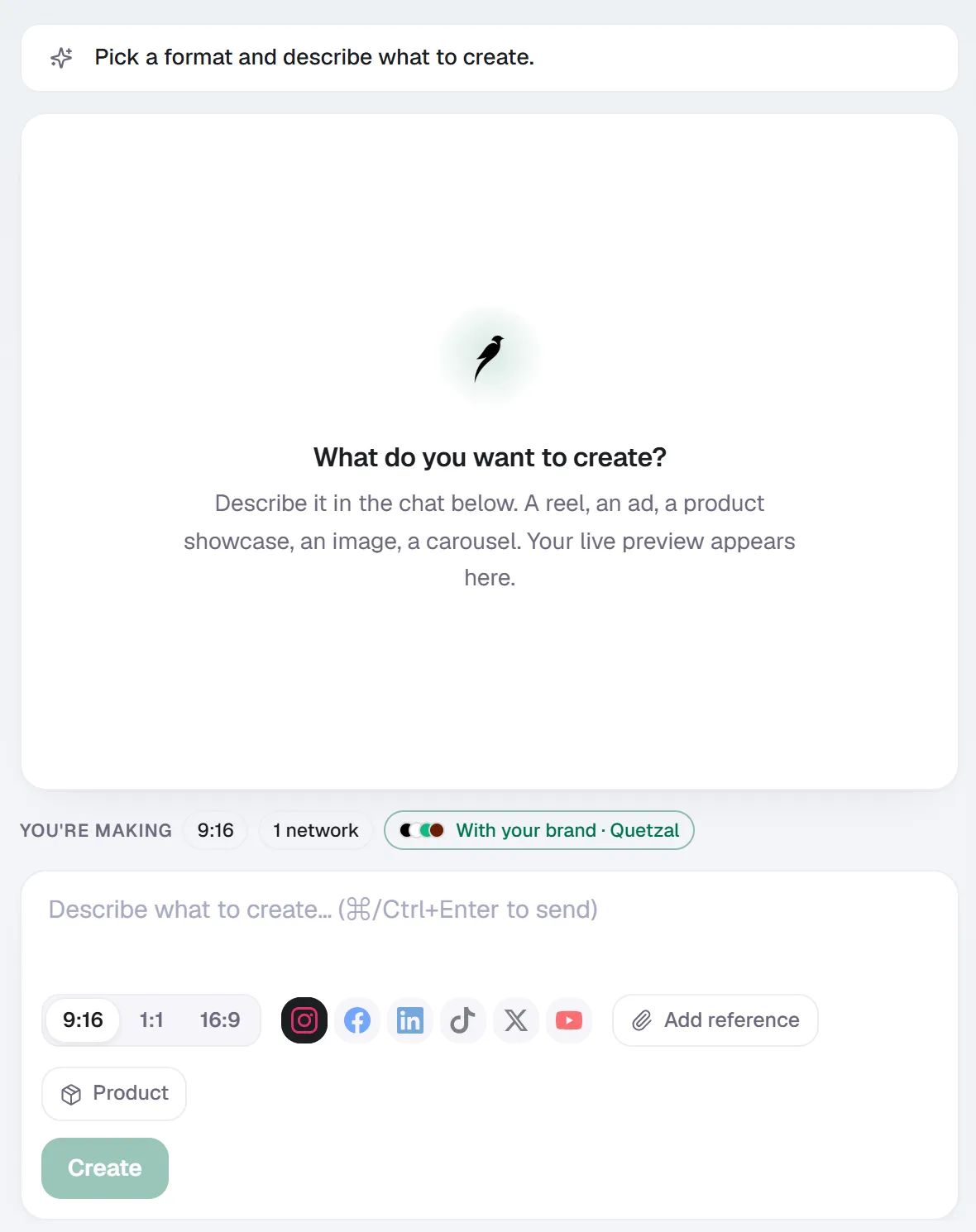
Create in Quetzal: describe the piece in a sentence, pick the format and the networks, and it is made with your brand applied.
The mechanics of an modern content generator
Early generative tools functioned primarily as conversational text engines, requiring operators to copy text into external design apps.
In 2026, an effective AI social media content generator integrates three distinct operational layers: brand identity extraction, multi-format layout synthesis, and platform-specific distribution.
The first layer ingests brand guardrails. Rather than relying on generic prompt instructions like "write in an authoritative tone," the system establishes a programmatic profile containing vector logos, typographic hierarchies, color palettes, and curated product imagery.
This ensures that every visual asset adheres to established brand identity standards without requiring post-generation manual adjustments.
The second layer is asset synthesis. When the generator receives an editorial topic, it does not stop at drafting a caption.
It constructs visual layouts: computing bounding boxes for typography, verifying contrast ratios against background assets, and structuring multi-frame slides for carousels.
For short-form video, it writes the script, selects pacing, synthesizes a voiceover, layers word-synced subtitles, and compiles the final render into a vertical video container.
The third layer handles contextual publishing:
- A LinkedIn post demands structured paragraphs, professional hooks, and specific document formats.
- Instagram relies on visual carousels, clean aspect ratios, and concise narrative captions.
- TikTok and YouTube Shorts prioritize kinetic motion and audio balance.
The generator adapts the core message to meet the technical and cultural standards of each destination network.
Copy assistants versus full-stack visual generation
The social media software market contains two distinct categories of generative tools: text-only assistants and full-stack creative engines.
Text-only assistants focus solely on generating copy for captions or short status updates. These tools are commonly embedded directly inside traditional scheduling dashboards like Buffer, Hootsuite, or Later.
While helpful for overcoming writer's block, text assistants address less than twenty percent of the labor required to run an active brand channel.
The marketing team must still complete the remaining manual tasks:
- Source imagery
- Open external software to lay out graphics
- Adjust fonts
- Export files
- Manually re-upload assets into the scheduler
Text Assistant:
Prompt -> Text Output -> Manual Design -> Manual Assembly -> Scheduler

Full-Stack Generator:
Topic/URL -> Layout Engine + Copy + Audio -> Finished Render -> Direct Publishing
Full-Stack visual engines treat copy as just one component of a unified creative asset.
By handling the typography, visual composition, and motion design simultaneously, these systems generate finished files that can be reviewed and deployed immediately.
Teams interested in the operational differences between raw copy generation and automated administration can read our breakdown of what an AI social media manager actually does.
Comparing approaches to social media generation
Choosing the right tool requires understanding how different architectures handle asset creation, asset storage, and publishing workflows.
The table below outlines how standard generative software categories compare across critical functional requirements.
| Capability | Copy-First Assistants | Template Automators | Autonomous Creative Engines |
|---|---|---|---|
| Primary Output | Raw text captions | Pre-made templates with swapped text | Designed statics, carousels, and video renders |
| Brand Identity | Basic tone settings | Manual font and color selection | Programmatic extraction of fonts, palette, and logos |
| Video Production | Script outlines only | Stock video clips with static text overlays | End-to-end renders with script, voiceover, and captions |
| Channel Adaptation | Character count limits | Manual resizing per platform | Native aspect ratios, carousels, and formats |
| Publishing Flow | External or manual sync | Built-in basic scheduler | Native direct publishing via official platform APIs |
| Telemetry Loop | Platform analytics pass-through | Generic vanity metrics | Scheduled interval tracking to refine generation |
Template automators like Ocoya or Predis.ai offer partial steps toward automation by mapping AI text into static graphic templates.
However, autonomous creative engines like Quetzal eliminate manual canvas work by generating finished posts, carousels, and video reels using the brand's own fonts, palette, and assets.
Marketing teams assessing broader software categories can review our comparative guide to the best AI social media tools.
Technical requirements for automated video reel generation
Vertical short-form video on Instagram Reels, TikTok, and YouTube Shorts has become the primary driver of reach on consumer platforms.
However, video is notoriously labor-intensive. Producing an effective ten-to-thirty-second reel typically requires scripting, voice recording, asset sourcing, timeline editing, caption alignment, and format rendering.
An advanced AI social media content generator handles these steps through an automated pipeline:
- Script generation: The system writes a hook, body points, and a call to action structured specifically for retention, avoiding the generic introductions common in general-purpose language models.
- Audio synthesis: The script is converted to spoken audio using realistic voice models that maintain natural cadence, volume dynamics, and pronunciation.
- Subtitle synchronization: The audio timeline is parsed to generate word-synced subtitles, ensuring text hits the screen precisely as the syllable is spoken.
- Visual assembly and rendering: Background video or high-resolution imagery is cropped to vertical dimensions, layered beneath the dynamic typography, and rendered into an optimized MP4 file ready for distribution.
By handling the video render on the server, the generator bypasses third-party mobile editing apps, allowing brands to maintain a consistent video presence without dedicating days to manual post-production.
Performance telemetry and feedback loops
A generation pipeline that operates without performance feedback will inevitably produce stale, disengaging content.
Most scheduling software, such as Metricool or Publer, records engagement metrics for reporting purposes, but that data rarely influences what the user creates next. In contrast, an intelligent generation engine uses closed-loop telemetry.
Social media algorithms distribute content through progressive phases: initial delivery to a small core audience, evaluation of engagement velocity, and subsequent expansion or suppression. Measuring a post at an arbitrary monthly interval fails to capture this dynamic.
Effective systems track asset performance across structured post-publication checkpoints:
- Hour 1: Evaluates immediate hook efficacy, comment activity, and initial algorithmic pickup.
- Hour 6: Measures second-tier distribution and early sharing patterns.
- Hour 24: Identifies peak reach limits and audience retention stability.
- Hour 72: Captures the full long-tail lifecycle of the post across network discovery feeds.
These metrics provide directional signals back to the generative engine.
If high-contrast carousel slides yield longer read times on LinkedIn, or if specific voiceover tempos increase reel completion rates on Instagram, the engine weights those variables more heavily when assembling assets for the following week.
You can learn more about how Quetzal's self-improving publishing engine operates under this closed-loop model.
Operational workflows: autonomy versus approval
Implementing an AI generator does not require giving up editorial control. Organizations must determine the appropriate balance between operational velocity and brand safety.
Under an approval-based workflow, the generator creates a complete week of multi-format content in advance, matching designated themes. Post drafts, visual assets, platform captions, and scheduled time slots appear inside an editorial review queue.
Team members or agency clients review the creative, make text or layout revisions if necessary, and approve each asset with a single click.
Approval Mode:
Drafting -> Review Queue -> Client or Manager Approval -> Scheduled Publication

Autonomous Mode:
Brand Guidelines Established -> Generation -> Automated Quality Check -> Direct Publication
Under a fully autonomous workflow, the generator functions as an autopilot.
Working within standing brand guidelines, predefined publishing cadences, and content categories, the system creates, schedules, publishes, and measures content without human intervention.
This setup is particularly effective for high-frequency channels, secondary brand accounts, or resource-constrained teams that need a reliable, professional baseline of activity across six networks simultaneously.
See generative production applied to your website
Evaluating an AI social media content generator comes down to how effectively it eliminates manual production while preserving brand standards.
Quetzal does the actual production work by generating designed static posts, carousels, stories, and full video reels with synced audio and captions across six networks.
Every asset uses your business's own logo, palette, fonts, and product photos instead of generic templates.
In addition, the engine gets better every week because it measures each post at 1, 6, 24, and 72 hours to plan upcoming content around what worked.
To generate a real week of branded content for your business in about 3 minutes without signing up, try it free on your own website.
Frequently asked questions
Can an AI content generator match our exact brand guidelines?
Modern generative engines extract vector logos, color codes, custom fonts, and photography rules directly from your digital assets. This ensures every graphic and video uses your exact visual identity rather than generic layout presets or mismatched typefaces.
How do AI content generators publish to social networks?
Generators connect to networks through official developer APIs for platforms like Instagram, Facebook, LinkedIn, TikTok, X, and YouTube.
Once assets are generated and approved, the system schedules and posts them directly without requiring third-party webhooks or mobile notifications.
Does an AI content generator replace social media managers?
Generators eliminate the operational overhead of asset production, graphic layout, resizing, and manual scheduling.
This allows marketing teams and social media managers to focus on high-level positioning, community engagement, and overarching business strategy instead of routine production tasks.
Really made with Quetzal
Real product output, untouched. What you see is what it generates.