Deep dive · September 1, 2026
Social media content calendar for small business
Build a social media content calendar for small business with this practical framework covering cadence, tools, templates and AI automation.
 By Jaime · Co-founder of Quetzal

A social media content calendar for a small business is a schedule that maps out what you post, where, and when, usually planned two to four weeks ahead and organized by platform, theme and campaign.
It keeps your posting consistent without daily improvisation, and it's the single easiest way to stop social media from eating your week. Below is a working framework you can copy today, plus where automation genuinely saves time.
For businesses that struggle to keep up with production, Quetzal does the work instead of just organizing it, generating designed posts, carousels, stories, captions, and video reels in your brand's own visual identity before publishing across six platforms.
You can try it free on your own website to see a full week of branded content created in about 3 minutes. Every post is then measured over 72 hours to plan the following week, keeping your calendar active without manual daily design.
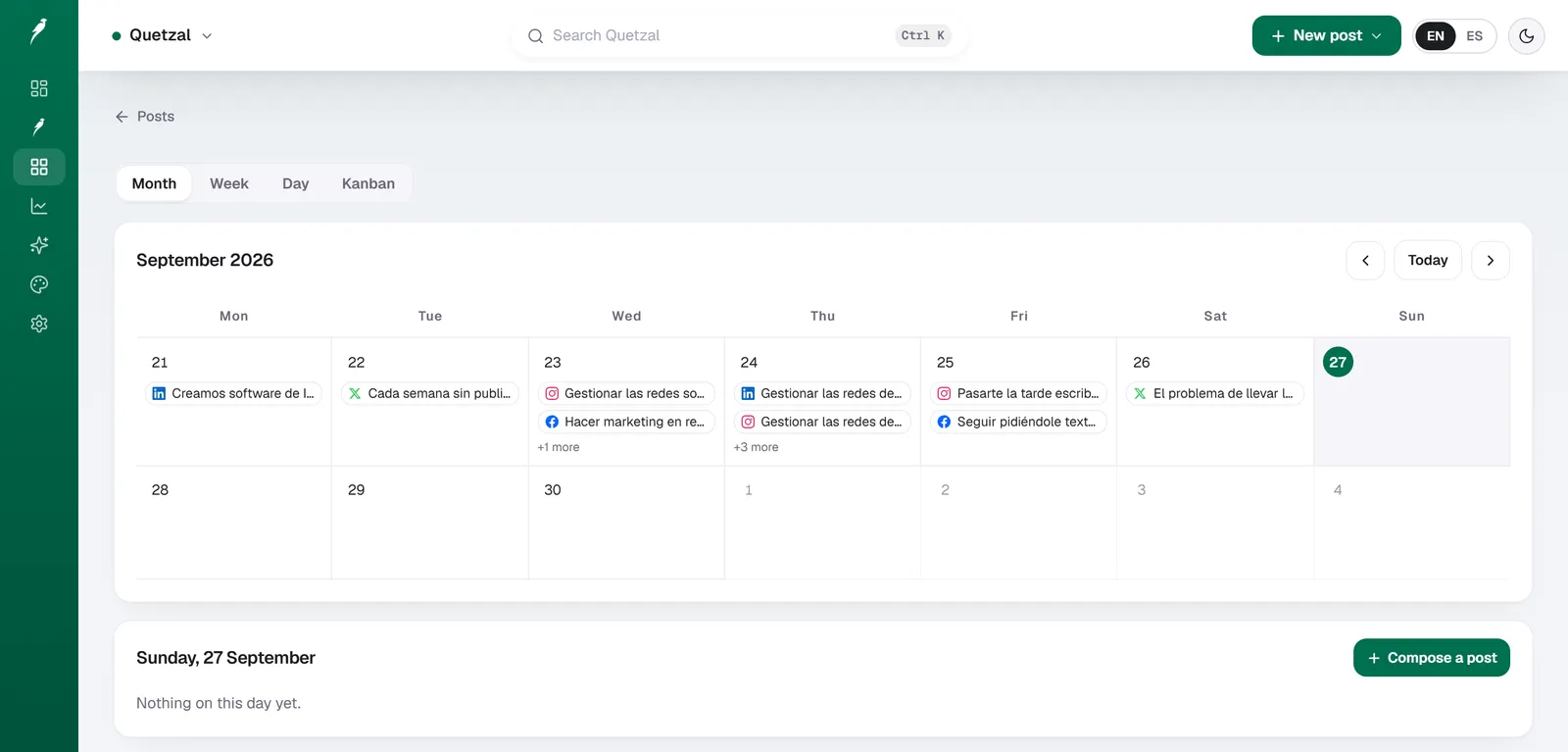
The Quetzal calendar on our own account in September 2026: every post the autopilot planned for LinkedIn, X, Instagram and Facebook, and underneath, the posts still waiting for approval. Our account publishes in Spanish.
What is a social media content calendar
A content calendar is a document or tool that lists, for each planned post: the date and time, the platform, the format (photo, carousel, video, story), the caption or headline, the visual asset, and the goal (awareness, engagement, sales). For a small business, it usually spans one month at a time and covers two to four platforms.
The calendar does three jobs a memory or a notes app can't:
- It separates planning from publishing, so you decide what to say once a week instead of every morning under pressure.
- It shows gaps before they happen, like three product posts in a row with no story, question or behind-the-scenes content.
- It gives you a record of what you posted and when, which is the only way to later compare what worked.
Without one, most small businesses default to posting when they remember, which produces long silent gaps followed by bursts, the pattern platforms penalize most in reach.
What should a small business content calendar include
At minimum, a usable calendar has these columns:
- Date and time of publishing, matched to when your audience is actually active, not a generic "best time to post" chart.
- Platform, because a LinkedIn caption and an Instagram caption should never be identical.
- Format, since a static image, a carousel and a Story serve different purposes (a carousel explains, a Story reminds, a static post announces).
- Content pillar, a repeating theme such as product, education, behind-the-scenes, customer proof or promotion. Three to five pillars is enough for most small businesses.
- Caption draft and hashtags, written in your brand voice, not generic filler.
- Visual asset or link to the design file, so nothing gets built the night before.
- Call to action, one per post: visit, save, comment, buy, book.
- Status, a simple draft, approved, scheduled, published flow so nothing gets posted twice or missed.
A spreadsheet with these eight columns is a fully functional calendar. The tool matters less than the discipline of filling it in before the week starts, not during it.
How to build a social media content calendar step by step
- Pick your platforms first, not last. Most small businesses do better on two or three platforms posted well than five posted thinly. Instagram and Facebook for local and retail, LinkedIn for B2B, TikTok for younger consumer audiences.
- Set your pillars. Write down three to five recurring content types. Example for a small café: new drinks, behind-the-counter, customer moments, local events, offers.
- Set your cadence. Decide a realistic number of posts per platform per week (see the next section) and stick to it for a month before changing it.
- Block a weekly or monthly planning session. Fill in dates, pillars and formats for the next two to four weeks in one sitting.
- Batch the visuals. Design or shoot several posts at once rather than one at a time; this is where most small businesses lose the most hours.
- Write captions in a separate pass. Captions get better when written after the visuals exist, not before.
- Schedule ahead using a tool. Manual daily posting is the single biggest reason calendars fall apart after week two.
- Review performance weekly, not monthly. Weekly reviews let you catch what's underperforming while it's still cheap to fix.
How often should a small business post on social media
There's no universal number, but a sustainable baseline that most small businesses can maintain without burning out is:
- Instagram and Facebook: 3 to 5 feed posts per week, plus daily or near-daily Stories.
- LinkedIn: 2 to 3 posts per week, consistency matters more than volume here.
- TikTok: 3 to 5 short videos per week if you can sustain video production; fewer, consistent posts beat sporadic bursts.
- X: daily or near-daily, since the platform rewards frequency and real-time relevance.
The honest rule: a cadence you can hold for three months straight beats an ambitious one you abandon after ten days. Build the calendar around your actual production capacity, then raise the cadence once it's stable.
Free template vs scheduling tool vs AI automation
Small businesses generally reach for one of three approaches. A spreadsheet template costs nothing and forces discipline, but you still design, write and post everything by hand.
A scheduling tool (Buffer, Hootsuite, Later, Metricool, Publer, Ocoya) automates the publishing step and often adds basic analytics, but you still have to produce the graphics and captions yourself, usually in a separate design app.
AI content tools (Predis.ai, Quetzal) go a step further and generate the actual post, not just the posting time.
| Approach | What it does for you | What you still do | Fits best |
|---|---|---|---|
| Spreadsheet / free template | Structure and planning | Design, writing, posting | Solo founders, very early stage |
| Scheduling tool (Buffer, Hootsuite, Later, Metricool, Publer, Ocoya) | Queues and publishes at set times, basic analytics | Designing graphics, writing captions | Businesses with an existing designer or template set |
| AI social autopilot (Quetzal, Predis.ai) | Generates on-brand posts, captions and schedule; some run fully autonomously | Setting brand guidelines and approving output (optional) | Small teams with no dedicated designer or social manager |
Quetzal, built in Málaga by two founders, sits in the third category: it generates designed static posts, ads, carousels, infographics, stories and captions in your brand's own visual identity (your logo, palette, fonts and product photos), then schedules and publishes them to Instagram, Facebook, LinkedIn, TikTok, X and YouTube.
It measures every post at 1, 6, 24 and 72 hours after publishing and uses that data to adjust the next week's content, which is closer to a rolling performance loop than a static calendar.
AI video reels are generated end to end too: script, voiceover, synced captions and the final edit.
How much time does a content calendar actually save
Most of the time cost in social media isn't the calendar itself, it's the production behind it: opening a design tool, finding on-brand templates, resizing for each platform, writing a caption, then manually posting or scheduling. A calendar template organizes decisions but doesn't remove that production work.
A scheduling tool removes the manual posting step. An AI autopilot removes design and caption production too, which is usually the largest single time sink for a small business without a dedicated marketer.
This is also where the "run it yourself or let it run itself" choice matters. Quetzal can operate fully autonomously under standing brand guidelines you set once, or require your approval on every post before it goes live, and you choose which mode fits your comfort level.
A founder who wants oversight keeps it; a founder who wants social media off their plate entirely can hand it over.
Pricing runs from Starter at 79 EUR/month up to Ultra at 899 EUR/month, billed annually, with a 7-day free trial available using a launch code, and the platform is natively authored in both English and Spanish rather than translated.
How to keep a content calendar consistent long-term
Consistency fails for three predictable reasons, and each has a direct fix:
- Running out of ideas. Fix it by keeping a running list of content pillars and rotating them, rather than starting from zero each week.
- Running out of time. Fix it by batching design and writing in one weekly session instead of daily, or automating that step entirely.
- No feedback loop. Fix it by checking which posts perform best at least weekly and adjusting the next batch, not waiting for a monthly report that arrives too late to act on.
The businesses that keep posting consistently past the three-month mark are almost always the ones that removed friction from production, not the ones with the fanciest calendar template.
Frequently asked questions
What's the best free tool for a social media content calendar?
A Google Sheet or Notion table with columns for date, platform, format, caption, visual and status covers everything a small business needs to start. Free tiers of Buffer, Later or Metricool add scheduling on top, but you'll still design and write content separately.
How far in advance should a small business plan social media content?
Two to four weeks is the practical sweet spot: far enough ahead to batch production and catch gaps, close enough to react to real-time events, seasonal moments or a post that's suddenly performing well.
Can AI create a full month of social media content for a small business?
Yes, tools built for this, including Quetzal, can generate a full month of on-brand posts, captions and a publishing schedule across platforms like Instagram, Facebook, LinkedIn, TikTok, X and YouTube, either fully autonomously or with your approval on each post before it publishes.
See it on your own brand
A content calendar only works when you have the visual assets and copy to fill it. Quetzal handles the production work instead of just organizing it, creating designed posts, carousels, stories, captions, and AI video reels in your brand's own visual identity with your logo, palette, fonts, and product photos.
It publishes across six platforms from one dashboard, adapting content to each network so you never have to reformat manually.
Because every post is measured at 1, 6, 24, and 72 hours, the next week of content is planned directly from what worked, while you maintain full control to approve each post or let it run on autopilot.
To see a full week of planned, branded posts generated in about 3 minutes without signing up, try it free on your own website.
Really made with Quetzal
Real product output, untouched. What you see is what it generates.