Comparison · August 29, 2026
Predis.ai vs Canva for social posts: 2026 comparison
Predis.ai vs Canva for social posts compared on design, automation, scheduling and pricing, plus where an autopilot tool like Quetzal fits in.
 By Sergio · Co-founder of Quetzal

Predis.ai and Canva solve different problems: Canva is a design tool where you build social posts yourself from templates, while Predis.ai is an AI generator that drafts captions, hashtags and post visuals from a prompt or a product link.
If you want full creative control, Canva wins.
If you want speed and AI-first content generation with less manual design work, Predis.ai is closer to what you need, though neither is built to run your whole posting calendar on autopilot the way a dedicated social autopilot tool is.
Quetzal handles this by taking over both the creative production and the publishing, generating posts, carousels, stories and video reels directly in your brand's own logo, palette, fonts and product photos.
It publishes across six platforms and learns from post performance each week, while letting you keep control through full autopilot or per-post approval.
You can try it free on your own website to see a week of branded content created in about 3 minutes without signing up.
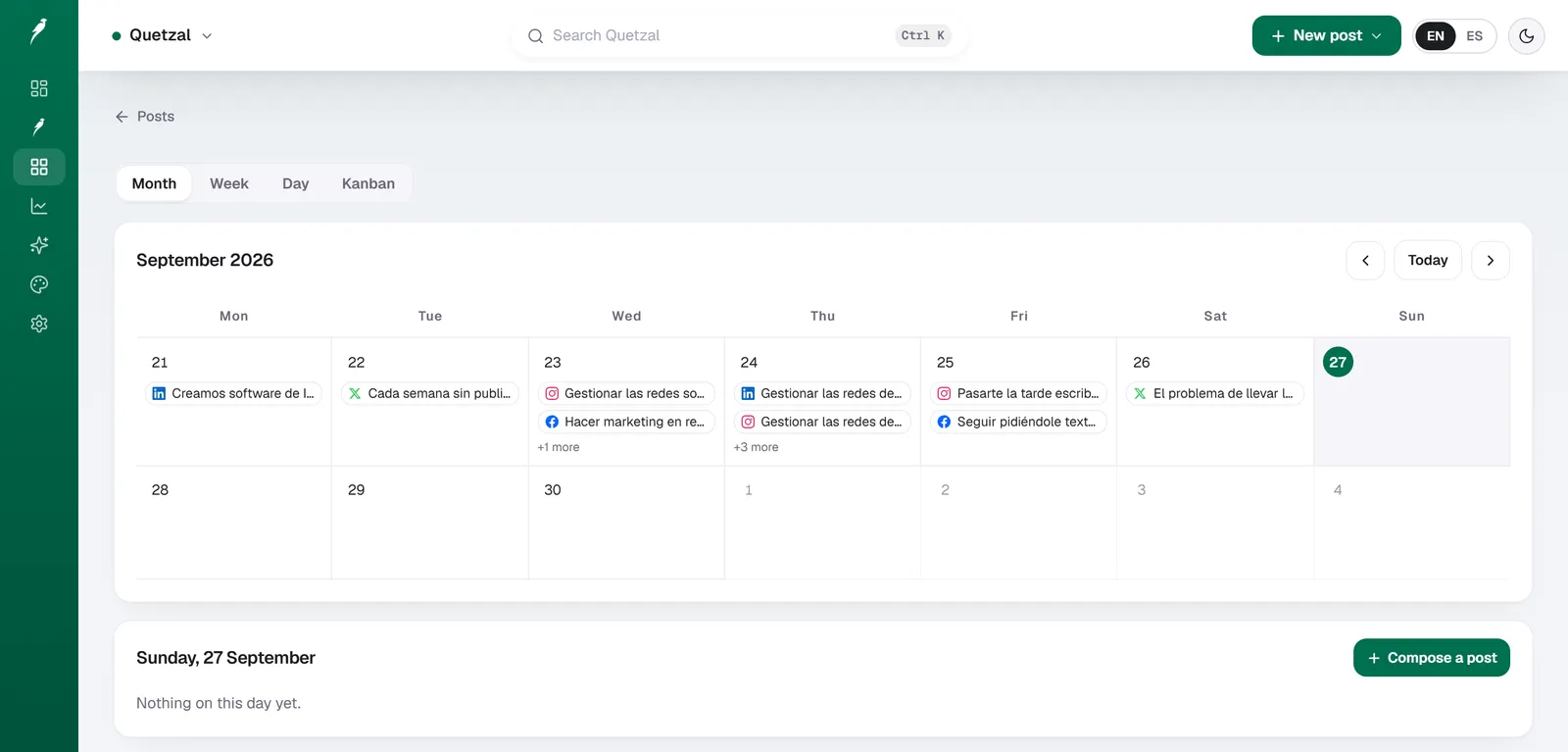
The Quetzal calendar on our own account in September 2026: every post the autopilot planned for LinkedIn, X, Instagram and Facebook, and underneath, the posts still waiting for approval. Our account publishes in Spanish.
Quetzal
Quetzal is an AI social media autopilot that creates the content, designs it in the brand's own visual identity, publishes it and learns from the results.
It carries out three core tasks:
- Generates designed static posts, ads, carousels, infographics, stories, captions and AI video reels using your logo, palette, fonts and product photos
- Schedules and publishes across Instagram, Facebook, LinkedIn, TikTok, X and YouTube
- Measures every post at 1, 6, 24 and 72 hours to improve the next week's content
It fits businesses and agencies in Spain, the rest of Europe and the United States that want autonomous posting under standing brand guidelines or with per-post approval.
Pricing starts at 79 EUR/month billed annually (89 USD/month in the United States and outside Europe) on the Starter plan, with a 7-day free trial, card required, nothing charged today.
The main drawback is that it is a young product, built by two founders in Málaga.
What Predis.ai and Canva actually do differently
Canva started as a design app and has stayed one. Its core strength is a drag-and-drop editor with thousands of templates, stock assets, and brand kit features (logo, colors, fonts) that you apply manually to each post.
Canva added AI features over time (Magic Design, text-to-image, background removal), but the workflow is still "you open the app, pick or generate a layout, and edit it."
Scheduling exists through Canva's own publishing tool for a subset of platforms, but it's a secondary feature bolted onto a design product.
Predis.ai is built the other way around. You give it a product URL, a topic, or a competitor handle, and it generates a batch of caption and visual options using AI, aimed mostly at small businesses and agencies that want quick content without opening a design canvas.
It includes basic scheduling, a content calendar, and some analytics.
The visuals it produces are AI-generated or template-based rather than pulled from your actual product photography, which matters if brand accuracy is important to you.
The practical difference: Canva assumes you (or a designer on your team) will do the creative work with better tools. Predis.ai assumes AI should do the first draft of both copy and image, and you clean it up.
Which one produces better-looking, more on-brand posts
Canva generally wins on design polish because you're controlling every element, and its template library is deep and current.
The tradeoff is time. Post by post, someone still has to:
- Open the editor
- Swap images
- Adjust text
- Resize for each platform
- Export
Predis.ai's AI-generated visuals are faster to produce but less predictable. They can drift from your actual brand palette, logo placement, or product photography because the AI is generating imagery rather than working from your real assets.
For a personal brand or an agency turning out volume content on tight timelines, that tradeoff can be worth it.
For an ecommerce or hospitality brand where photo accuracy and consistent brand identity matter on every post, it's a weaker fit.
This is the gap tools like Quetzal are built to close. It generates static posts, ads, carousels, infographics and stories using your actual logo, palette, fonts and product photos rather than generic AI-generated imagery.
As a result, the output stays recognizably yours without you touching a design canvas.
Scheduling, publishing and multi-platform support
Neither Canva nor Predis.ai was built primarily as a scheduling engine, and it shows once you look past single-post publishing.
Canva's Content Planner lets you schedule to a handful of networks and view a calendar, which is fine for occasional posting but limited if you're managing six platforms with different formats and cadences.
Predis.ai includes a calendar and auto-scheduling for its generated content, plus some competitor and trend tracking, but the platform coverage and posting reliability vary by plan tier and aren't the product's main focus.
If cross-platform scheduling (Instagram, Facebook, LinkedIn, TikTok, X, YouTube) with actual performance tracking after each post is what you need, dedicated social schedulers typically handle that better than either Canva or Predis.ai:
- Buffer
- Hootsuite
- Later
- Metricool
- Publer
Publishing and analytics are their core product rather than an add-on to design or AI generation.
Pricing: what you actually pay for
Canva's free tier covers basic design and light scheduling. Canva Pro and Canva for Teams add brand kits, more AI credits and multi-user features, priced per seat.
Predis.ai runs on tiered monthly plans based on the number of AI-generated posts and social accounts connected, with higher tiers unlocking more generations, competitor tracking and team seats.
Here's how the two compare against a full autopilot approach on the dimensions that usually decide the choice:
| Tool | Core function | Uses your real brand assets | Content types | Scheduling & multi-platform publishing | Post-performance tracking | Approval workflow | Who does the design work |
|---|---|---|---|---|---|---|---|
| Quetzal | End-to-end AI social autopilot | Yes, logo/palette/fonts/product photos automatically | Posts, ads, carousels, infographics, stories, captions and video reels | Instagram, Facebook, LinkedIn, TikTok, X, YouTube | Measures every post at 1, 6, 24, 72 hours to inform next week | Fully autonomous or per-post approval, your choice | AI, under standing brand guidelines |
| Canva | Manual design editor | Yes, manually applied | Static posts, some video/animation | Basic, limited networks | Minimal | Manual by default | You |
| Predis.ai | AI caption + visual generator | Limited, AI-generated visuals | Static posts, captions, some video | Basic, tier-dependent | Basic analytics | Manual by default | AI, lightly editable |
For someone comparing tools by price alone, Canva's free and Pro tiers are cheaper if you're happy doing the design work yourself.
Predis.ai's plans sit in a similar bracket to Canva Pro but add AI generation credits instead of design flexibility.
Tools built to run the full cycle, generation through scheduling through performance-based iteration, tend to sit at a higher monthly price because they're replacing more of the workflow, not just one step of it.
Which one should you actually choose
Pick Quetzal if the bottleneck isn't designing faster, but having the time to plan, design, schedule, and check what worked.
Quetzal was built by two founders in Málaga specifically for that gap. It generates designed static posts, carousels, infographics, stories, captions and video reels in your actual brand identity (logo, palette, fonts, product photos).
It publishes across six platforms, and tracks each post at 1, 6, 24 and 72 hours so the following week's content adjusts based on what actually performed.
It runs fully autonomously under standing brand guidelines or with per-post approval, whichever a team prefers, and is available in natively authored English and Spanish.
Plans start at 79 EUR/month (Starter) up to 899 EUR/month (Ultra), billed annually (Starter 89 to Ultra 999 USD/month in the United States and outside Europe), with a 7-day free trial, card required, nothing charged today.
Pick Canva if:
- You or someone on your team enjoys designing
- You need fine-grained control over every visual
- Posting volume is low enough that manual work per post isn't a bottleneck
- Your main use case extends beyond social, print materials, presentations, or documents, where Canva's general-purpose design library pays off
Pick Predis.ai if:
- You want AI to draft both copy and visuals quickly for small-business or agency social accounts
- You're comfortable with AI-generated imagery rather than your own product photos
- Your priority is speed over brand-asset precision
FAQ
Is Predis.ai good for small businesses without a designer?
Yes, for basic output. It removes the need to open a design tool by generating captions and visuals from a prompt or product link, which suits a small business posting occasionally with no design resource.
The limitation is that the AI-generated imagery may not match your actual product photos or exact brand palette, so posts can look slightly generic compared to hand-built brand assets. It's a reasonable starting point, not a full replacement for a brand-consistent content system.
Can Canva schedule posts automatically like a social media autopilot?
Canva's Content Planner can schedule posts to a limited set of networks and shows a basic calendar view, but it wasn't built as a publishing or analytics engine. It doesn't track post performance over time or adjust future content based on results.
For that level of automation, teams typically pair Canva with a dedicated scheduler, or move to a tool built around the full generate-publish-measure cycle.
What's the cheapest way to automate social media posts in 2026?
Canva's free tier plus manual scheduling is the lowest-cost option if your time is unpaid or you enjoy the design work. Beyond that, cost depends on how much of the workflow you want automated: caption and visual generation only (Predis.ai's tier structure), scheduling and analytics only (Buffer, Metricool, Publer), or the full cycle of brand-matched design, cross-platform publishing and performance-based iteration, which tools like Quetzal price from 60 EUR/month on the Starter plan, with a 7-day free trial to test before committing.
More on this: Ocoya alternative for startups: what to pick in 2026.
See it on your own brand
Instead of manually editing templates in Canva or relying on generic AI images from Predis.ai, Quetzal does the work end to end by generating posts, carousels, stories, captions and video reels using your real logo, palette, fonts and product photos.
It publishes directly across six platforms with your choice of full autopilot or per-post approval, and measures every post at 1, 6, 24 and 72 hours so your content gets better every week. Anyone can see how it looks on their own business by typing their website at the free demo.
Really made with Quetzal
Real product output, untouched. What you see is what it generates.