Deep dive · September 2, 2026
Social media marketing strategy for small business
A practical social media marketing strategy for small business: platforms, budget, posting cadence, tools and how to measure results without a big team.
 By Jaime · Co-founder of Quetzal

A social media marketing strategy for small business means picking one or two platforms where your customers actually spend time, publishing consistently in your own visual identity, and reviewing performance often enough to adjust before a campaign is over. It does not require an agency retainer or a full-time hire.
The sections below cover budget, platform choice, posting frequency, design, tools and measurement, in enough depth that you can act on any single one.
Quetzal handles this entire workflow by generating static posts, carousels, stories, captions and video reels in your brand visual identity, then publishing them across six networks. Because it measures performance at 1, 6, 24 and 72 hours, the next week of content automatically improves based on what worked.
You can try it free on your own website to see a week of tailored posts in about 3 minutes.
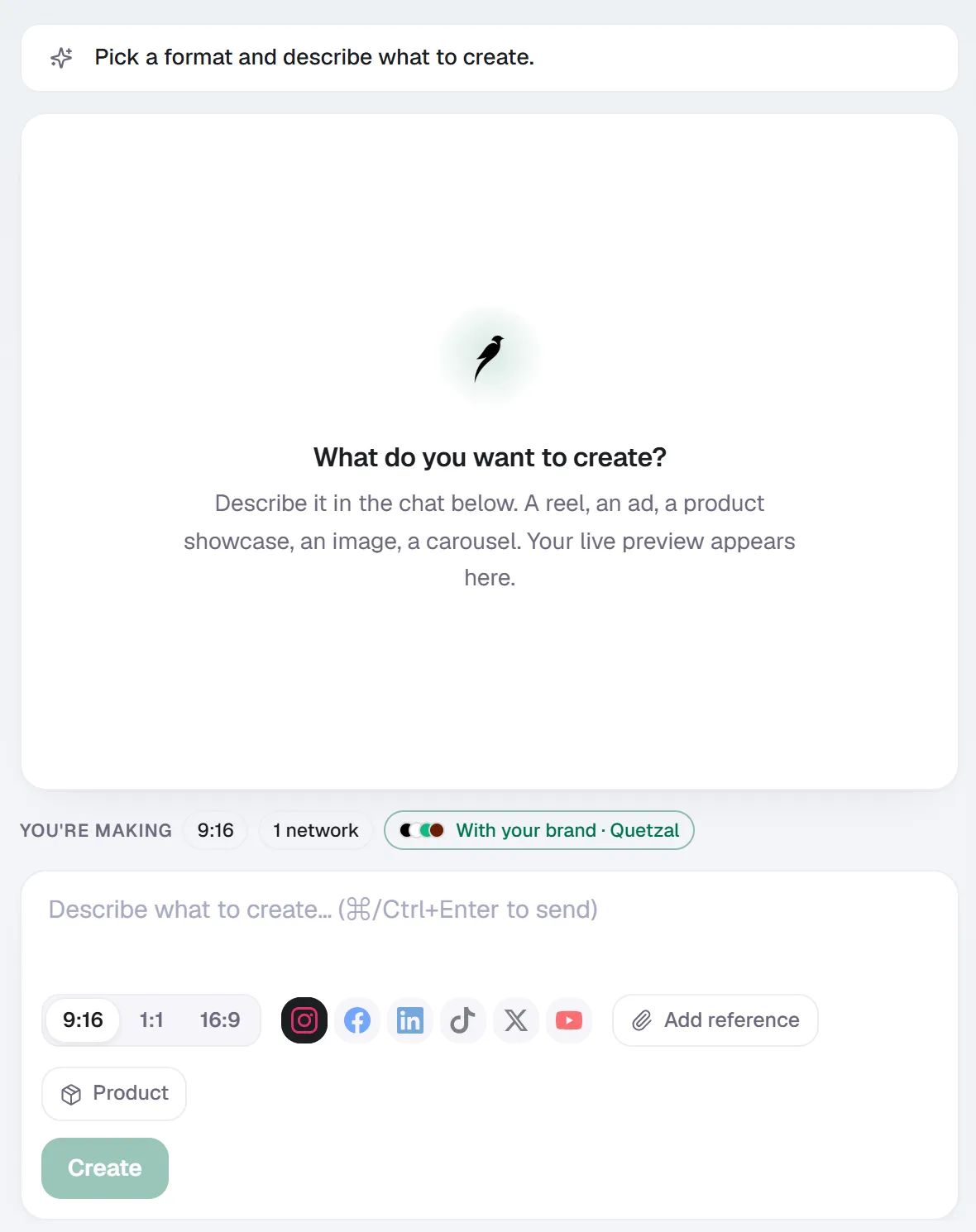
Create in Quetzal: describe the piece in a sentence, pick the format and the networks, and it is made with your brand applied.
What does a social media marketing strategy for small business actually include?
At minimum, a working strategy has five parts:
- A defined audience and platform, not "social media" in general. A local bakery and a B2B SaaS company should not be running the same playbook.
- A content mix that alternates promotional posts, educational or behind-the-scenes content, and social proof (reviews, testimonials, before/after).
- A visual identity applied consistently: same logo placement, palette, fonts and photo style across every post, so the feed is recognizable even without the caption.
- A publishing cadence you can sustain for months, not weeks.
- A review cycle where you look at what worked and adjust the next batch of content.
Most small businesses fail on parts 4 and 5, not part 1. They pick a platform correctly, post for two weeks, then stop because it takes too long to design and schedule content manually.
The strategy that survives is the one that fits inside the time you actually have each week.
How much should a small business budget for social media marketing?
There is no universal number, but the budget generally splits into three buckets:
- Content creation and scheduling tools: typically 30 to 300+ EUR/month depending on how much of the design and publishing work you want automated versus doing by hand.
- Paid promotion: even a modest 100 to 300 EUR/month in boosted posts or ads can outperform organic-only reach on Instagram and Facebook, where organic distribution has shrunk.
- Time, which is the real cost most owners underestimate. Manually designing, writing captions and scheduling for three platforms can easily consume 5 to 8 hours a week.
If your time is the constraint, tools that generate on-brand designed posts and schedule them automatically (Quetzal, Buffer, Hootsuite, and others below) reduce the hours-per-week cost, which is often the deciding factor for a business with no marketing hire.
Which platforms should a small business prioritize?
Prioritize based on where your buyers already look for businesses like yours, not where you personally prefer to post.
- Instagram: strong for retail, hospitality, beauty, fitness and any visually-driven product. Carousels and Stories perform well for product showcases and offers.
- Facebook: still relevant for local services and an older customer base, and it is where local business reviews and community groups live.
- LinkedIn: the default for B2B, professional services and recruiting-adjacent content.
- TikTok: growing fast for consumer brands with a younger audience, but demands more short-form video output than most small teams can sustain alone.
- X: useful for real-time updates, customer support visibility and niche B2B communities, less useful as a primary growth channel for most small businesses.
- YouTube: high effort, long payoff, best treated as a secondary channel unless video is core to the business.
A realistic small-business approach is one primary platform done well, plus one secondary platform fed with repurposed content, rather than five platforms updated inconsistently.
How often should small businesses post on social media?
Consistency matters more than volume. A sustainable cadence that most small businesses can maintain:
- Instagram and Facebook: 3 to 5 posts a week, plus daily or near-daily Stories.
- LinkedIn: 2 to 4 posts a week.
- TikTok: 3 to 5 short videos a week if video is part of the plan, since infrequent posting rarely gains traction on the platform.
- X: daily, but lightweight, since the format rewards frequency over polish.
The exact number matters less than whether you can hold the cadence for at least three months without burning out. A schedule you keep at 3 posts a week beats one you abandon after 10 posts in week one.
How can small businesses keep content on-brand without a designer?
This is where most DIY social media efforts visibly fall apart: inconsistent fonts, mismatched colors, stretched logos, stock photos that do not match the product. Three practical options:
- Build a simple brand kit once (logo files, 2-3 brand colors, 1-2 fonts, a handful of product photos) and reuse it in a design tool like Canva for every post, manually.
- Hire a freelance designer for a batch of templates you then fill in yourself each week.
- Use an AI tool that already knows your brand identity and generates designed posts, carousels, infographics and captions automatically. This is the gap Quetzal is built for: it takes a business's logo, palette, fonts and product photos and produces static posts, ads, carousels, infographics, stories and captions in that identity, then schedules and publishes them across Instagram, Facebook, LinkedIn, TikTok, X and YouTube.
Whichever route you choose, the test is simple: could a customer recognize your post as yours with the logo covered up? If not, the visual identity part of the strategy is not done yet.
What tools help small businesses run social media without a full team?
The table below compares the main options a small business is likely to consider.
| Tool | Best for | Design generation | Autonomous posting | Notes |
|---|---|---|---|---|
| Quetzal | Brand-consistent content on autopilot | Yes, in brand's own identity | Yes, fully autonomous or per-post approval | Static posts, ads, carousels, infographics, stories, captions; measures at 1/6/24/72h; AI video reels generated end to end |
| Buffer | Simple scheduling | No | No | Good for teams who design content elsewhere |
| Hootsuite | Multi-platform management | Limited | No | Stronger for larger teams and reporting |
| Later | Visual content calendar | No | No | Popular for Instagram-first brands |
| Metricool | Analytics plus scheduling | No | No | Strong reporting, weaker on content creation |
| Publer | Budget scheduling | No | No | Good entry-level scheduler |
| Ocoya | AI captions and light design | Some | No | AI writing assistance, less brand-specific design |
| Predis.ai | AI post generation | Yes, template-based | No | Generates content ideas and drafts |
Most tools in this list solve scheduling or analytics, but leave the design and the actual weekly decision-making to you.
Quetzal is built to close both gaps: it runs the whole loop of designing, scheduling, publishing and improving content on its own under standing brand guidelines, with the option to require approval on each post if you prefer to stay in the loop.
Pricing runs Starter at 79 EUR/month, Growth at 199, Pro at 449 and Ultra at 899, billed annually, with a 7-day free trial available with a launch code. It is authored natively in both English and Spanish rather than translated, which matters for businesses operating in bilingual markets.
How do you measure whether your strategy is working?
Vanity metrics like follower count matter less than these four:
- Engagement rate (likes, comments, shares relative to reach): tells you if content is resonating, not just being seen.
- Reach and impressions over the first 24 to 72 hours: most organic posts do the bulk of their reach in this window, so early performance is a reliable predictor of total performance.
- Click-throughs and profile visits: the bridge between social attention and actual business inquiries.
- Conversion from social: track a discount code, a landing page or a "how did you hear about us" field so social gets credit for actual sales or bookings.
Checking performance at fixed intervals (for example, 1 hour, 6 hours, 24 hours and 72 hours after publishing) rather than only at the end of the month lets you spot which content format or posting time is working while there is still time to adjust the following week's content.
This is the logic Quetzal applies automatically to every post it publishes, feeding those four checkpoints back into what it creates next.
Put your small business social media strategy on autopilot
Executing a consistent strategy does not require hours of manual design or high agency retainers. Quetzal creates on-brand posts, carousels, captions and AI video reels using your exact logo, colors, fonts and product photos, then publishes them across Instagram, Facebook, LinkedIn, TikTok, X and YouTube.
It tracks engagement at 1, 6, 24 and 72 hours to refine future content automatically, while giving you the choice between full autopilot and per-post approval. To see a complete week of customized content created in about 3 minutes with no signup required, try it free on your own website.
FAQ
How long does it take to see results from a social media marketing strategy?
Meaningful engagement trends usually show up within 4 to 8 weeks of consistent posting, but conversions into actual customers typically take 3 to 6 months, especially for organic-only strategies. Paid promotion can shorten this, but the underlying content and brand consistency still need time to build recognition.
Do small businesses need to be on every social media platform?
No. One platform done consistently and well outperforms five platforms updated sporadically. Choose the primary platform based on where your customers already look for businesses like yours, then add a second channel only once the first is running on a stable cadence.
Can a small business run social media marketing without hiring anyone?
Yes, particularly with tools that handle design and scheduling automatically. A single owner can maintain a consistent, on-brand presence across several platforms using an autopilot tool like Quetzal, a scheduler paired with a design tool like Canva, or a freelancer for periodic template batches, depending on how much time versus budget the business has to spend.