Deep dive · September 5, 2026
Social media marketing trends for small business (2026)
The social media marketing trends for small business owners need in 2026: AI content, short video, multi-platform posting and what to skip.
 By Sergio · Co-founder of Quetzal

The biggest social media marketing trends for small business in 2026 are AI-generated content that keeps a brand's visual identity consistent, short-form video across more platforms than just TikTok, and performance data that reshapes next week's posts instead of sitting in a dashboard nobody reads.
Owners with no design or ad budget are the ones benefiting most, because these tools remove the two things that used to require an agency: design skill and posting discipline.
Quetzal handles this shift by generating static posts, carousels, captions and video reels directly in a brand's own visual identity, publishing them across six networks without relying on generic templates. Because it measures every post at 1, 6, 24 and 72 hours, future content continuously adapts to what works.
You can try it free on your own website to see how it builds a week of posts from your existing branding.
Below is what's actually changing, what's noise, and how a small business with limited time can act on it this year.
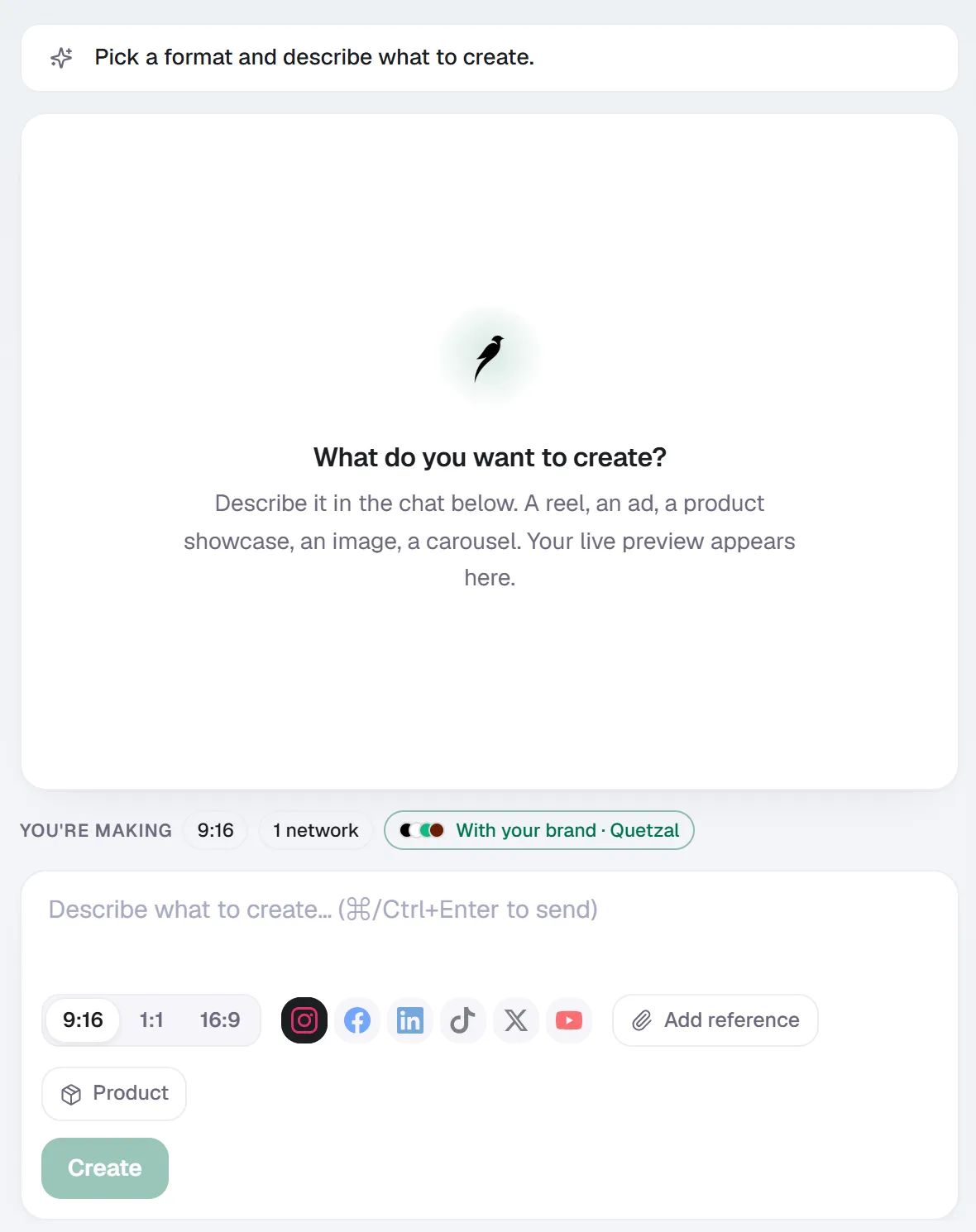
Create in Quetzal: describe the piece in a sentence, pick the format and the networks, and it is made with your brand applied.
What's actually new in 2026, not just recycled advice
A few shifts are real and measurable in how platforms and audiences behave, not just marketing-blog filler:
- AI-native content production. Small businesses no longer need a designer to produce on-brand posts. Tools now generate static posts, carousels, infographics and captions that already match a brand's logo, colors, fonts and product photos, instead of generic templates.
- Multi-platform by default. Instagram-only strategies are losing ground. LinkedIn now drives real B2B leads for small service businesses, TikTok and X still matter for reach, and YouTube (including Shorts) has become a discovery engine even for local brands.
- Performance feedback loops. Rather than checking analytics once a month, the trend is measuring posts at short, fixed intervals (an hour in, a day in, three days in) so the next batch of content is adjusted based on what actually worked, not gut feeling.
- Autonomous but controllable posting. Business owners want to set brand guidelines once and let content go out on schedule, but they still want an approval switch for sensitive periods (a product recall, a PR moment, a new launch).
- AI visibility, not just search visibility. As more customers ask AI assistants for recommendations, brands are starting to check how those assistants describe them, alongside classic SEO.
None of this requires a bigger budget than 2025. It requires a smarter stack.
Which platforms should a small business actually prioritize this year
There's no universal answer, but the decision logic is now clearer:
- Instagram and Facebook remain the default for retail, hospitality, and local services because of Meta's ad targeting and the visual-first format.
- LinkedIn has become essential for B2B small businesses (agencies, consultants, SaaS, professional services). Organic reach for founder-led posts is still strong.
- TikTok works best for consumer brands with a visual or entertaining product, and increasingly for behind-the-scenes small-business storytelling.
- X is lower-effort but still useful for real-time updates, customer service visibility, and niche communities (tech, finance, local news).
- YouTube, especially Shorts, is becoming a second search engine. Small businesses publishing short explainer or demo clips are showing up in search results that used to be text-only.
Most small businesses don't have the hours to manually adapt one campaign into six different formats and posting cadences. This is where automation tools matter less as a convenience and more as the only realistic way to be present everywhere at once.
Quetzal, for example, generates and schedules posts, stories, carousels and captions across Instagram, Facebook, LinkedIn, TikTok, X and YouTube from a single brand identity, so the same campaign doesn't have to be rebuilt six times by hand.
AI video reels are generated end to end too: script, AI voiceover, word-synced captions and a finished edited render, extending the same approach to Reels and Shorts.
How AI content generation is changing small business social media
Three years ago "AI content" meant generic stock-style graphics or robotic captions. In 2026 the more useful version is narrower: AI trained on a specific brand's assets (logo, color palette, fonts, real product photos) producing posts that look like they came from that brand's own designer, not a template library.
For a small business this matters for three practical reasons:
- Consistency without a design hire. A coherent visual identity across profiles is one of the strongest low-cost brand signals, and it's one most small businesses fail at simply from time pressure, not lack of taste. If you want to see how consistent your own profiles currently look, Quetzal's brand consistency checker is a free way to audit that before changing anything.
- Speed. A week's worth of platform-appropriate posts (not one post reformatted six times) used to take hours. Generation tools that already understand a brand's identity cut that down to minutes.
- Self-improvement. The value isn't just producing content, it's producing content that gets measured and adjusted. Quetzal checks each post's performance at 1, 6, 24 and 72 hours after publishing and uses that to shape the following week's content, so the account isn't guessing what worked.
This doesn't remove the owner from the loop unless they want it to. Autopilot can run under standing brand guidelines with no manual review, or require per-post approval, which matters for regulated industries, seasonal campaigns, or businesses that simply want a human check before anything goes live.
Is full automation safe for a small business's brand, or does it need review
This is the most common hesitation, and it's a fair one. Full automation is safe when three things are true: the brand guidelines given to the tool are specific (not just "keep it professional"), the business has reviewed at least one generated batch before turning off approval, and someone still checks performance weekly even if they're not approving individual posts.
Where per-post approval makes more sense:
- Highly regulated industries (finance, healthcare, legal)
- Businesses mid-crisis or mid-launch, where timing sensitivity is high
- Brand-new accounts still calibrating tone
- Franchises or multi-location businesses where local nuance matters
Where autopilot without per-post approval works well:
- Established small businesses with a settled visual identity and voice
- Owners who don't have time to review content weekly, and would rather set rules once
- Businesses posting at high frequency across many platforms, where manual review becomes the bottleneck
The right answer isn't "always automate" or "always review." It's matching the control level to how much risk a bad post actually carries for that specific business.
What to skip: trends that don't pay off for small business budgets
Not everything labeled a "2026 trend" is worth a small business's time:
- Chasing every new platform feature. Small teams lose more time experimenting with new formats (polls, AR filters, live shopping) than they gain in reach. Prioritize the platforms your customers actually use.
- Posting frequency for its own sake. More posts without a measurement loop just produces more content that nobody adjusts. Frequency without feedback is wasted effort.
- Influencer-only strategies. For most local and small B2B businesses, owned content that builds a consistent brand still outperforms one-off influencer spend, especially without a way to verify results.
- Ignoring AI visibility. As customers increasingly ask AI assistants (not just Google) for recommendations, a brand that has no consistent public information becomes invisible to those assistants too. This is a newer category worth a look, separate from classic social media metrics. Quetzal's AI visibility checker shows how a brand currently shows up in AI-assisted answers.
How much should a small business budget for social media tools in 2026
Tool pricing for small business social media management typically scales with posting volume and platform count, not with company size. A realistic small-business range looks like this:
| Plan tier | Typical monthly range | Fits |
|---|---|---|
| Entry | 50-80 EUR | Solo owner, 1-2 platforms, light posting cadence |
| Growth | 100-200 EUR | Small team, most platforms, regular weekly content |
| Pro | 250-350 EUR | Higher volume, multiple platforms, frequent campaigns |
| Ultra / agency-level | 500-700 EUR | Agencies or multi-brand accounts |
Quetzal's own tiers follow this pattern: Starter at 79 EUR/month, Growth at 199, Pro at 449, and Ultra at 899, all billed annually, with a 7-day free trial. Full plan details are on Quetzal's plans page.
Compared to the cost of a part-time social media hire or an agency retainer, tool-based automation is usually the cheaper entry point for a business testing whether consistent posting actually moves revenue.
Seeing these trends applied to your own brand
Instead of just scheduling content you have to design yourself, Quetzal does the actual production work by generating static posts, carousels, captions and complete video reels from your brand assets.
Every piece uses your specific logo, color palette, fonts and product photos across six platforms, ensuring your content looks like your business rather than a generic template.
It also measures performance at 1, 6, 24 and 72 hours so each week's plan improves from real data, while giving you the choice between full autopilot and per-post approval. You can generate a week of branded content for your business in about three minutes at the demo.
What is the most important social media trend for small business in 2026
Consistency powered by AI-native content generation. Businesses that keep a coherent visual identity across every platform, and adjust content based on short-interval performance data rather than monthly guesswork, are outperforming those simply posting more often.
Do small businesses still need to post on every platform
No. Prioritize the one or two platforms where your actual customers spend time, then expand once that's working. A B2B consultancy likely gets more from LinkedIn than TikTok; a retail brand is usually the reverse.
Tools that publish across Instagram, Facebook, LinkedIn, TikTok, X and YouTube from one brand identity make expanding into additional platforms low-cost once the core strategy works, which is one reason to check how the product works before deciding how many platforms to run.
How can a small business tell if its social media content is actually working
Look past likes and followers. The more useful signal is performance at set intervals after publishing (an hour, a day, three days) compared week over week, which shows whether adjustments to content, timing or format are actually improving results, rather than just producing more posts.