Deep dive · August 25, 2026
Content scheduling platform pricing for agencies: 2024 to 2026
Compare content scheduling platform pricing for agencies from 2024 and 2025 through 2026. Explore workspace costs, seat fees, and automated production.
 By Sergio · Co-founder of Quetzal

Content scheduling platform pricing for agencies typically ranges from $17 to upwards of $200 per month on entry tiers, scaling by seats, profiles, or dedicated client workspaces.
True agency costs depend on whether platforms penalize roster growth with per-user fees, gate approvals behind enterprise tiers, or include creative asset generation in publishing workflows.
Rather than just organizing files your team has already designed, Quetzal operates as an AI social media autopilot that generates branded static posts, carousels, and video reels across six networks from 79 EUR (89 USD) per month.
You can see the free demo on your website to generate a week of branded content in three minutes without creating an account.
Managing social media across a multi-client roster introduces operational bottlenecks that single-brand tools cannot solve. When an agency expands from three clients to fifteen, queuing posts manually becomes unsustainable.
Agencies must navigate segregated client environments, client review friction, multi-network publishing permissions, and software fee structures that directly affect gross retainers.
How content scheduling platform pricing changed from 2024 to 2026
Between 2024 and 2025, software vendors restructured agency plans away from simple flat-rate subscriptions toward segmented models. Platforms introduced tiered seat licensing, metered AI text credits, and separate billing for external client reviewers.
These changes altered agency margins. A tool that appeared economical at $50 per month frequently doubled or tripled in cost once an agency added account managers, junior copywriters, and client approvers.
In 2026, agencies evaluate three distinct software cost components:
- Base subscription fees
- Profile expansion costs
- User seat surcharges
When onboarding a new client, an agency rarely connects a single social profile. A standard client presence requires profiles on Instagram, Facebook, LinkedIn, TikTok, X, and YouTube.
A single new client account absorbs six profile slots. Under scheduling platforms that cap connected profiles at 10 or 20 accounts across the entire subscription, onboarding two new clients forces an immediate upgrade to a higher software tier.
Similarly, user seat caps create administrative friction. If an agency employs three strategists and serves eight clients who each demand sign-off rights before posts go live, a platform that charges per seat penalizes collaboration.
The agency must either share master credentials (violating security standards) or pay recurring monthly fees for client seats that log in for only five minutes each week.
Understanding how platform vendors structure these limits allows agencies to forecast software expenses accurately before pitching new client retainers.
Comparing agency pricing models: seat fees, profile caps, and workspaces
Scheduling tools employ four distinct billing architectures. Identifying which model a vendor uses reveals whether your software expenses will remain stable as your client roster expands.
1. Per-seat billing architectures
Per-seat pricing charges a fixed monthly fee for every individual user login. While common among enterprise-level suites, this structure penalizes collaborative agency teams.
Adding internal designers, freelance copywriters, and external client reviewers multiplies software overhead. For agencies managing high client volumes on lean retainers, seat-based billing quickly erodes account profitability.
2. Profile-capped tier architectures
Profile-capped billing grants access to a specific number of connected social profiles (such as 10, 20, or 40 profiles) regardless of how many brands those profiles represent. This model works well when clients only maintain one or two active networks.
However, modern clients expect cross-platform distribution.
When each client requires five or six network integrations, a 20-profile allowance accommodates only three complete client accounts before requiring plan upgrades or extra profile add-on fees.
3. Dedicated workspace architectures
Workspace-based billing organizes tools around segregated client environments. Each workspace houses its own content calendar, connected profiles, social queues, and media libraries.
Vendors utilizing this structure, such as Sendible, allocate a baseline bundle of profiles per workspace.
This isolates client data, prevents staff from publishing assets to the wrong brand feed, and provides predictable software budgeting per client account.
4. Autonomous creative autopilot architectures
The newest pricing architecture pairs dedicated client workspaces with generative production engines.
Instead of functioning purely as a post queue for pre-made files, platforms like Quetzal generate branded visual designs, copywriting, and video content directly inside each client workspace.
Pricing scales per workspace, eliminating seat penalties while replacing external graphic design and copywriting subscriptions.
The table below contrasts how leading agency platforms structure their pricing, profile limits, and collaboration tools.
Source: Published vendor pricing and feature documentation, 2026.
| Platform | Entry agency pricing | Billing architecture | Client approval access | Content generation capability |
|---|---|---|---|---|
| SocialPilot | $17/mo Essentials ($85/mo Premium) | Per account tier and user | Unlimited clients (Premium tier) | Text caption credits |
| Sendible | Core plan (workspace model) | Per workspace (6 profiles included) | Unlimited users per workspace | AI text assistant |
| Planable | Workspace tier | Per workspace and user seat | Multi-stage visual approvals | Basic text assistance |
| Quetzal | €79/mo or $89/mo (billed annually) | Per client workspace | Autopilot or per-post approval | Autonomous static posts, carousels, ads, and video reels |
Social media scheduling tools for agencies: detailed platform breakdowns
Evaluating agency scheduling software requires comparing concrete feature inclusions, account caps, and day-to-day workflow mechanics.
SocialPilot
SocialPilot pricing provides tiered management software structured for independent professionals, small businesses, and scaling marketing agencies.
The platform centralizes multi-account scheduling, basic analytics, and client management into a unified dashboard.
On annual billing, SocialPilot offers four standardized tiers:
- Essentials: $17 per month (€16.15 per month billed annually; or $20 / €19 monthly). Includes 5 social accounts, 1 user seat, and 500 AI credits. Additional accounts cost $4 per month.
- Standard: $34 per month (€32.30 per month billed annually; or $40 / €38 monthly). Includes 10 social accounts, 3 user seats, 1,000 AI credits, bulk scheduling, social inbox, and team collaboration. Extra accounts cost $4 per month; extra user seats cost $5 per month.
- Premium: $85 per month (€80.75 per month billed annually; or $100 / €95 monthly). Includes 20 social accounts, 6 user seats, 5,000 AI credits, client approval workflows, and white-label PDF reports. Extra accounts cost $4 per month; extra user seats cost $5 per month.
- Ultimate: $170 per month (€161.50 per month billed annually; or $200 / €190 monthly). Includes 40 social accounts, unlimited user seats, unlimited client seats, unlimited AI credits, advanced white-label dashboards, and a dedicated account manager. Extra accounts cost $4 per month.
For agencies, SocialPilot's Premium tier represents the practical entry point because client approval workflows and white-label reporting are omitted from the Essentials and Standard plans.
The platform allows agencies on Premium and Ultimate to invite external clients to approve upcoming posts without paying separate client seat fees.
The operational constraint with SocialPilot centers on creative production. While the platform supports bulk CSV uploads and text generation credits, it does not design visual assets, build multi-slide carousels, or render edited video reels.
Agency staff must still create all visual media in external software before scheduling.
Sendible
Sendible pricing targets marketing agencies and consultancies that require segregated client workspaces and centralized social inboxes.
Sendible structures its software around the workspace concept. A workspace functions as a dedicated environment with its own profiles, queues, monitoring tools, and performance reports.
According to Sprout Social's scheduling tools review, Sendible stands out for multi-client agency workflows due to its organized client dashboards and reporting tools.
On its Core plan, Sendible provides:
- 1 workspace containing 6 connected social profiles.
- Unlimited user seats, enabling agencies to add team members, freelancers, and clients without extra seat fees.
- Unlimited post scheduling across all connected profiles.
- Unlimited AI credits for caption writing and post ideation.
- Social inbox monitoring and reply handling.
- Bulk scheduling tools and pre-built analytical reports.
Sendible's inclusion of unlimited user seats inside each workspace removes the financial penalty of adding client reviewers.
However, because each workspace includes 6 profiles, onboarding clients with broader channel footprints requires purchasing additional profile allocations.
Like SocialPilot, Sendible functions as an administrative distribution engine; it organizes and publishes media files but cannot autonomously produce designed brand graphics or video assets.
Planable
Planable is engineered specifically to eliminate approval bottlenecks between marketing teams and external stakeholders.
Rather than presenting raw data tables or disconnected queues, Planable renders draft posts as visual mockups that mirror live feeds on Instagram, Facebook, LinkedIn, TikTok, and X.
According to Planable's scheduling guide, the platform organizes team and client conversations directly alongside draft posts, replacing chaotic email chains and spreadsheets.
Details on Planable pricing highlight a workspace-driven structure where agencies configure subscriptions based on active client workspaces and user access levels.
Planable's primary agency feature is its multi-stage approval engine. Agencies can configure four distinct approval states:
- None (open publishing without review gates).
- Simple (one-click sign-off from any authorized reviewer).
- Multi-level (sequential sign-offs, such as internal agency review followed by client review).
- Timed (automatic publishing if no objections are raised within a defined window).
External clients can leave point-and-click feedback, suggest copy edits, and approve content from desktop or mobile interfaces.
The trade-off with Planable is that it focuses on planning and collaboration rather than creative asset generation or in-depth performance analytics.
Agencies must produce all images, graphics, and video clips externally before uploading them to Planable for review.
Quetzal
Quetzal is an AI social media autopilot built in Málaga, Spain, by two founders.
While traditional scheduling tools require human teams to write every caption, design every graphic, render every reel, and manually place files into a calendar, Quetzal automates creative production alongside publishing.
Quetzal fits forward-thinking marketing firms and content agencies seeking to expand client rosters without adding junior creative payroll. For a deeper look at scaling agency client portfolios, review our guide to agency social media automation.
Quetzal generates designed static posts, ad creatives, carousels, infographics, stories, and captions formatted strictly within each client's unique visual identity. The system applies the client's real logo, color palette, brand typography, and product photography.
In addition to static and carousel formats, Quetzal produces complete AI video reels end to end, generating the script, AI voiceover, word-synced subtitles, and edited video render, publishing the finished file automatically.
Agencies assign each client to an isolated workspace and choose how each account runs: full autopilot under standing brand guidelines, or per-post agency review.
Every post published to Instagram, Facebook, LinkedIn, TikTok, X, and YouTube is tracked and measured at 1, 6, 24, and 72 hours. Quetzal uses that engagement data to refine the following week's scheduled output.
Content is natively authored in both English and Spanish.
On annual billing, Quetzal's plans are:
- Starter: 79 EUR per month (89 USD per month outside Europe).
- Growth: 199 EUR per month (229 USD per month outside Europe).
- Pro: 449 EUR per month (499 USD per month outside Europe).
- Ultra: 899 EUR per month (999 USD per month outside Europe).
Agencies operate one workspace per client and receive portfolio discounts starting from their third client.
A 7-day free trial is available to test the platform; a payment card is required to initiate the trial, but nothing is charged until day 8.
The boundary to consider is that Quetzal is built specifically for autonomous content creation and multi-platform publishing.
Agencies looking for legacy PR media monitoring or enterprise customer-support ticketing suites will find Quetzal focused on branded content production and distribution.
First-hand experience: managing client review workflows without seat penalties
Agency client management breaks down when clients are forced to navigate complicated software interfaces.
When an agency asks a busy business owner to register a software seat, set a password, and navigate an enterprise publishing backend just to approve four social posts, the client inevitably stops logging in. Drafts stall, scheduling queues empty, and retainers are jeopardized.
In our own client operations at Quetzal, we removed client logins entirely. The review interface generates a clean, secure external link.
The client opens the link on their phone or desktop, reviews the generated visual layouts and copy exactly as they will appear live, and clicks to approve or request edits.
The approval queue in Quetzal: a client approves a post or asks for a change through a link, with no account and no seat, and underneath sits everything created but not yet published.
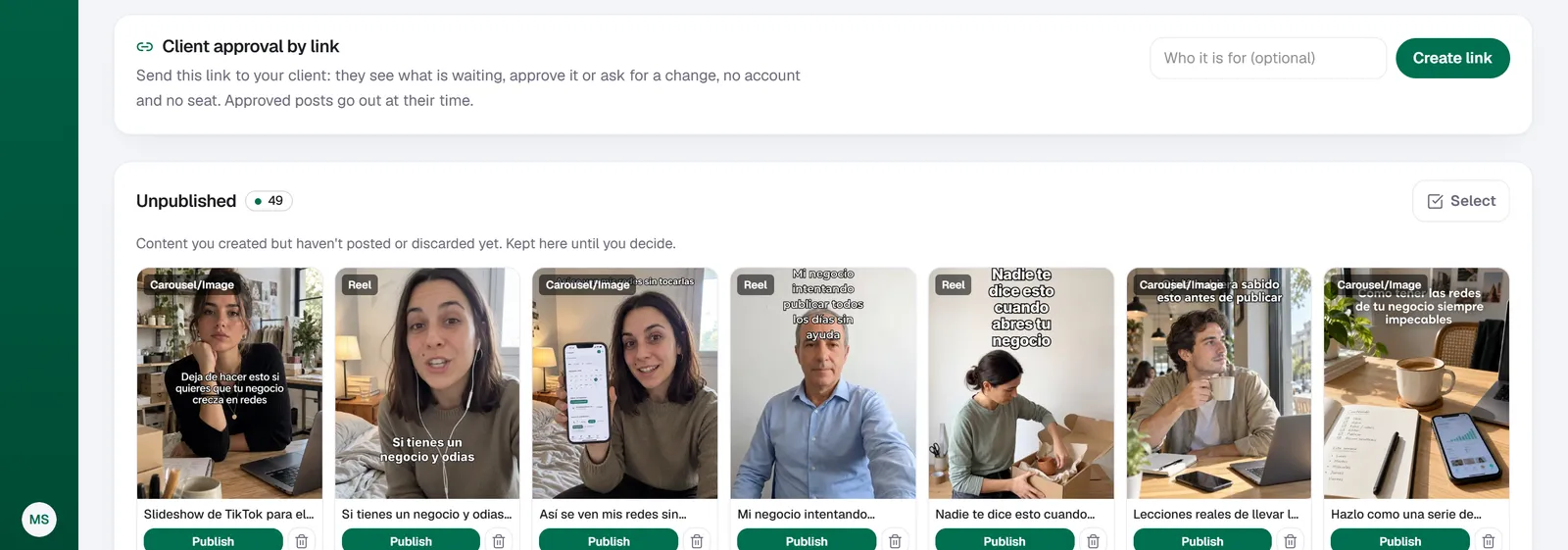
The approval queue in Quetzal: a client approves a post or asks for a change through a link, with no account and no seat, and underneath sits everything created but not yet published.
Eliminating mandatory user accounts for client approvers solves two operational problems simultaneously:
- It accelerates sign-off turnaround from days to minutes.
- It insulates the agency from software seat surcharges.
The agency can serve dozens of client reviewers across multiple workspaces without incurring extra monthly seat fees.
The hidden cost of scheduling: production payroll vs. queue management
When agencies audit software expenses, they often scrutinize whether a scheduler costs $85 or $150 per month.
However, focusing solely on scheduling software licensing overlooks the largest operational expense in social media management: creative production payroll.
Traditional schedulers only distribute files your team has already created. To feed a standard scheduling queue for one client across four platforms (publishing four posts per week), an agency typically expends:
- 4 to 6 hours of graphic design (static layouts, infographics, carousel slides).
- 2 to 3 hours of copywriting (network-specific captions, calls to action, hashtag research).
- 4 to 8 hours of video editing (sourcing b-roll, writing scripts, recording voiceovers, syncing subtitles).
- 1 to 2 hours of calendar assembly and scheduling.
Across a single client, content production requires roughly 11 to 19 hours of professional labor every month.
If your agency's blended internal labor cost is $40 per hour, producing content for that single client costs between $440 and $760 per month in payroll alone.
Traditional Workflow (Per Client / Month):
Graphic Design:   5 hours ($200)
Copywriting:      2.5 hours ($100)
Video Editing:    6 hours ($240)
Admin Scheduling: 1.5 hours ($60)
Total Internal Production Cost: ~$600 / month
When evaluating software, agencies must decide whether to hire additional staff or automate baseline production. For an in-depth breakdown of when human labor makes sense over automated workflows, read our comparison on hiring a social media manager versus software.
If an agency uses an autonomous platform like Quetzal to generate designed posts, carousels, and finished video reels inside client workspaces, baseline production hours drop toward zero.
Account managers shift their time from manual asset creation to strategic client consultation, improving gross margins across every active retainer.
Agencies evaluating generative systems can explore the technical criteria in our AI social media scheduler guide.
How to calculate your agency margin across client tiers
Forecasting agency profitability requires combining platform licensing, profile add-ons, and labor hours into a single unit-cost metric.
Use this baseline formula to calculate software overhead per client:
$$\text{Software Cost Per Client} = \frac{\text{Base Platform Fee} + \text{Profile Add-ons} + \text{Seat Surcharges}}{\text{Active Client Count}}$$
Consider how this applies across common agency growth stages:
Micro-agencies and solo consultants (1 to 5 clients)
Solopreneurs and boutique operators must keep fixed software overhead low while establishing consistent publishing routines.
If you design custom assets manually in third-party design tools, selecting a cost-effective distribution tool like SocialPilot's Standard plan ($34 per month billed annually for 10 accounts) keeps expenses under control.
Independent consultants can assess lean software setups in our review of the best social media scheduler for solopreneurs.
Growing boutique agencies (5 to 20 clients)
As client rosters expand beyond five accounts, manual content creation becomes a operational bottleneck. At 10 clients, your team must produce and schedule approximately 160 distinct social assets every month.
At this stage, agencies either hire additional junior creators or implement autonomous systems.
Deploying Quetzal across client workspaces allows a two-person team to service 15 clients without creative burnout, utilizing automated generation for baseline publishing while preserving human hours for custom campaigns.
Sibling agencies often organize these publishing cadences through a structured social media content calendar for small business.
Scaling multi-brand agencies (20+ clients)
Agencies managing 20 or more accounts must avoid platforms that enforce rigid per-seat licensing. An agency with 25 clients, 6 internal team members, and 25 external client reviewers will face unsustainable software invoices on per-seat enterprise tools.
At this scale, agencies deploy dedicated workspace platforms that offer portfolio pricing discounts.
High-performing agencies frequently segment their client roster: high-budget enterprise clients receive fully custom creative production, while standard small-business retainers run on automated Quetzal client workspaces with agency sign-off.
For performance-focused shops that prioritize complex advertising analytics and Looker Studio data over creative production, reviewing our comparison on Quetzal as a Metricool alternative provides an honest assessment of analytics-first versus generation-first tools.
Turn client websites into published social campaigns automatically
Traditional scheduling platforms only distribute what your team creates manually, leaving your agency to shoulder the payroll and time required for graphic design, copywriting, and video rendering.
Quetzal eliminates this production bottleneck by automatically generating designed posts, carousels, and finished video reels formatted in your client's authentic brand identity.
Every post published across six networks is tracked at 1, 6, 24, and 72 hours, using real engagement data to systematically improve future output while your team retains full control through optional per-post approvals.
You can test this workflow on any brand right now: enter a web address at the free Quetzal demo and generate a week of branded social content in three minutes.
FAQ
What is the typical content scheduling platform pricing for agencies?
Entry-level agency scheduling tiers typically range from $17 to $100 per month on annual billing, with platforms like SocialPilot charging $17 for 5 accounts on Essentials and $85 for 20 accounts with client approvals on Premium. Dedicated workspace platforms like Sendible structure plans around bundled profiles per workspace, while autonomous creative engines like Quetzal start at 79 EUR (89 USD) per month per client workspace, incorporating design, copywriting, and video production alongside scheduling.
How do per-seat and per-workspace pricing models compare for agencies?
Per-seat models charge recurring monthly fees for every team member and external client who accesses the platform, causing software overhead to scale rapidly as your agency grows. Per-workspace models isolate each client into a separate environment with bundled social profiles and often allow unlimited user seats, making software expenses predictable and aligned with individual client retainers.
Do agency scheduling tools include client approval workflows without extra fees?
Approval workflow availability depends on the platform and subscription tier. SocialPilot includes client approval workflows starting on its Premium tier ($85 per month billed annually), while Sendible includes unlimited users within workspaces on its Core tier.
Quetzal includes external client review links natively in every plan, allowing clients to review and approve posts without registering an account or consuming a paid seat.
Can a social media scheduling tool generate client content automatically?
Most traditional scheduling platforms only provide basic AI text generators for writing captions or generating hashtag ideas. Quetzal operates as an AI social media autopilot that generates complete static posts, infographics, carousels, and end-to-end edited video reels with voiceovers and captions matching the client's visual identity, scheduling and publishing them across six platforms automatically.
Sources
- Planable: best social media scheduling tools for 2026: https://planable.io/blog/schedule-social-media-posts/
- Sprout Social: best social media scheduling tools in 2026: https://sproutsocial.com/insights/social-media-scheduling-tools/
- Sendible pricing: https://www.sendible.com/pricing
- Planable pricing: https://planable.io/pricing/
- SocialPilot pricing: https://www.socialpilot.co/pricing
Really made with Quetzal
Real product output, untouched. What you see is what it generates.