Comparison · October 3, 2026
Vista Social vs Hootsuite: 2026 Comparison
Vista Social vs Hootsuite: compare pricing, seat limits, scheduling workflows, and agency features to see which social platform fits your team in 2026.
 By Sergio · Co-founder of Quetzal

Vista Social suits agencies and growing teams seeking affordable multi-profile scheduling, unlimited users on higher tiers, and integrated review management. Hootsuite serves mid-market brands needing legacy enterprise workflows, deep listening integrations, and strict seat-governed compliance. The deciding factor comes down to seat licensing versus profile volume, alongside whether your team drafts posts manually.
Choosing between Vista Social and Hootsuite in 2026 reflects a broader shift in social media management. On one side sits Hootsuite, an industry pioneer that has evolved into an enterprise-oriented governance suite.
On the other sits Vista Social, a modern platform built around post-pandemic networks like TikTok and YouTube Shorts, engineered to eliminate per-user seat penalties.
Both platforms eliminate the friction of native app switching, but their billing mechanics, feature depths, and intended team sizes diverge significantly.
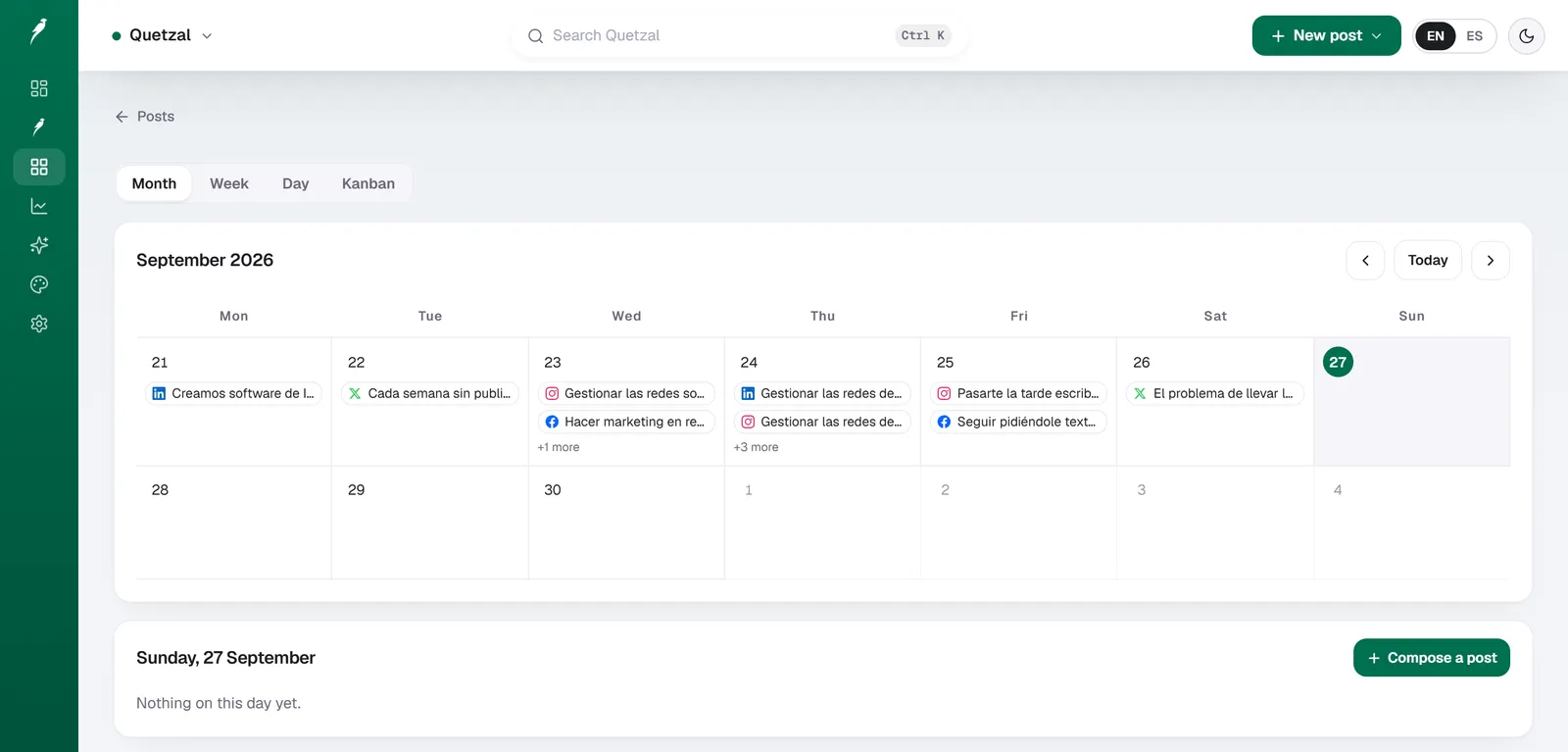
The Quetzal calendar on our own account in September 2026: every post the autopilot planned for LinkedIn, X, Instagram and Facebook, and underneath, the posts still waiting for approval. Our account publishes in Spanish.
Core architectural differences between Vista Social and Hootsuite
The primary distinction between Vista Social and Hootsuite lies in how each platform structures account access, channel connectivity, and operational overhead. Hootsuite isolates functionality behind user seats and channel bundles, while Vista Social decouples user counts from its core subscription tiers.
| Operational Area | Vista Social | Hootsuite |
|---|---|---|
| Source | Platform specifications, 2026 | Hootsuite plans and pricing, 2026 |
| Primary Pricing Metric | Per connected profile | Per user seat and profile bundle |
| User Seat Limits | Unlimited users on Pro and Enterprise tiers | Strict seat caps per plan (1 user on Professional, 3 on Team) |
| Short-Form Video | Direct auto-publishing to TikTok, Reels, Shorts | Direct auto-publishing to TikTok, Reels, Shorts |
| Social Listening | Core keyword and brand mention tracking | Owly-powered social listening and enterprise listening add-ons |
| Review Management | Built-in (Google Business, Facebook, Trustpilot, Yelp) | App Directory integrations and Enterprise-tier solutions |
| Employee Advocacy | Basic link sharing capabilities | Dedicated Amplify add-on module |
| Target Audience | Marketing agencies, creators, small-to-midsize teams | Mid-market businesses, regulated brands, global enterprises |
Hootsuite is engineered for organizations with strict audit requirements, compliance approval chains, and dedicated community management departments. Its unified dashboard aggregates complex social data streams across dozens of accounts.
Vista Social is built for operational speed. Its interface minimizes click depth for daily actions: scheduling multi-network carousels, responding to Google reviews alongside Instagram comments, and generating visual performance reports for external clients.
Pricing economics: per-seat licensing vs profile-based scaling
Pricing structure is the most common reason marketing teams evaluate these two tools against one another. The total cost of ownership diverges quickly as a team expands.
According to Hootsuite plans and pricing, Hootsuite structures its entry points around rigid user limits. The entry-level Professional plan supports 1 user and 10 social profiles.
Teams requiring collaboration must upgrade to the Team plan, which supports 3 users and 20 profiles. When an organization adds a fourth or fifth contributor, costs escalate into customized Enterprise tiers.
This seat-based architecture penalizes teams where multiple stakeholders, such as copywriters, designers, and managers, need periodic access to the calendar.
Hootsuite positions this model around security and administrative control. In Hootsuite's own comparison against competing platforms, Hootsuite frames its premium pricing as an investment in enterprise stability, certified integrations, and high-touch customer support.
Vista Social takes the opposing economic approach. Instead of gating seats, Vista Social bills based on connected social profiles. On its standard agency and collaborative plans, teams can invite unlimited users, assign role-based permissions, and manage external client approvals without incurring per-seat fees.
For an agency managing 30 social profiles across six team members, Hootsuite requires an enterprise-level tier or multiple Team seats with custom add-ons. Vista Social handles the same deployment at a fraction of the cost because billing scales with the client profile count rather than the agency roster.
Similar economics play out when comparing other modern tools, as detailed in our guide on SocialPilot vs Buffer.
Publishing workflows, content scheduling, and format support
Both tools handle core scheduling across major platforms: Instagram, Facebook, LinkedIn, TikTok, X, Pinterest, and YouTube. However, their day-to-day authoring interfaces feel markedly different.
Hootsuite features the Composer interface, a mature, modular publishing environment. It includes real-time previews for every network, an integrated Canva asset launcher, automatic hashtag suggestions, and link tracking parameters via custom Ow.ly shorteners.
Hootsuite excels at high-volume message queues, allowing teams to upload CSV bulk schedules with hundreds of posts mapped to distinct dates, accounts, and link tags.
Vista Social organizes its publisher around multi-format modern content. It provides native support for specific network features that emerged in recent years, including:
- First-comment scheduling for hashtags and attribution links across Instagram and LinkedIn.
- Direct audio picking and trending sound tagging for short-form video.
- Location tagging and user tagging directly from the compose window.
- Automated republishing queues (smart categories) that cycle evergreen assets without manual re-entry.
For visual planning, both tools offer grid previews for Instagram, helping social managers visualize aesthetic layout before publishing. Hootsuite offers more rigorous link-tracking governance, making it ideal for performance marketing teams tracking custom UTM configurations across campaigns.
Vista Social offers a more intuitive media manager with built-in integrations for Unsplash, Pexels, and Canva, coupled with automatic video transcription for accessibility subtitles.
Community engagement, inbox management, and brand monitoring
Managing comments, private messages, and customer inquiries is an area where organizational maturity dictates the better choice.
Hootsuite Inbox is an enterprise-grade conversation router. It consolidates incoming messages, public mentions, and post comments across connected channels into a single feed.
Messages can be automatically assigned to specific team members, tagged with sentiment labels, resolved with audit trails, and escalated according to service-level agreements (SLAs). If your team operates a dedicated support desk through social channels, Hootsuite provides the necessary routing controls.
Vista Social provides a unified inbox optimized for engagement and local business reputation. In addition to handling direct messages and comments from Instagram, Facebook, and TikTok, Vista Social pulls in customer reviews from Google Business Profiles, Facebook Pages, Yelp, and Trustpilot.
This review consolidation is a critical advantage for local businesses, multi-location franchises, and agencies serving service providers. A community manager can reply to a Google Business review and an Instagram DM within the same dashboard session. However, Vista Social lacks Hootsuite's automated SLA escalation workflows and enterprise ticket-routing logic.
For brand monitoring, Hootsuite provides customizable search streams. Users can build monitoring columns for industry keywords, competitor handles, and geographic terms directly in their daily dashboard. Vista Social offers social listening reports focused on brand sentiment and keyword mentions, but it does not replicate Hootsuite's real-time, multi-column streaming feed.
Agency client management and approval hierarchies
For marketing agencies, software architecture dictates operational margins. An agency needs to separate client data, invite external stakeholders for review, and white-label client deliverables without administrative gridlock.
Hootsuite handles agencies through its Organization and Team administrative structures. Agencies can partition accounts into distinct client teams, ensuring staff members only access accounts assigned to their pod. External client approvals, however, often require adding clients as designated users or routing approvals through email notifications, which quickly drives up seat costs on standard plans.
Vista Social was engineered specifically with agency multi-tenancy in mind:
- Client Workspaces: Profiles are grouped into isolated environments. Team members and client reviewers can be restricted to specific workspaces.
- Unlimited External Approvers: Agencies can send interactive calendar review links to clients. Clients can approve, reject, or comment on scheduled posts without needing a paid seat or navigating complex software.
- White-Label Reporting: Agency plans allow custom branding, logos, and domain masking on performance reports sent to clients.
Teams evaluating enterprise governance models often weigh these structural tradeoffs against tools like Sprout Social, as explored in our breakdown of Sprout Social vs Buffer.
The asset creation bottleneck: scheduling shells versus content generation
Whether you choose Vista Social or Hootsuite, both platforms operate on an underlying assumption: your team already has finished assets ready to schedule.
Both tools function primarily as distribution shells. They provide calendars, queues, and analytics, but they do not solve the production bottleneck.
Your team must still write the copy, design static carousels, shoot video assets, record voiceovers, and configure branding guidelines across every campaign. For many teams, filling the calendar in Hootsuite or Vista Social consumes 15 to 20 hours of manual creative production every week.
This operational friction is where the social media software category splits in 2026. Teams looking for alternatives to manual management frequently review options across our social software alternatives directory, contrasting traditional schedulers with modern automation engines.
+-------------------------------------------------------------+
|                  TRADITIONAL SCHEDULERS                     |
|                (Vista Social / Hootsuite)                   |
|                                                             |
|   [Manual Copywriting]  -->  [External Design / Canva]      |
|                                      |                      |
|                                      v                      |
|                           [Upload to Calendar]              |
|                                      |                      |
|                                      v                      |
|                             [Manual Scheduling]             |
+-------------------------------------------------------------+
                               vs
+-------------------------------------------------------------+
|                     AUTOPILOT ENGINES                       |
|                         (Quetzal)                           |
|                                                             |
|   [Brand Guidelines + URL]  -->  [Automated Post Generation]|
|                                  - Static Posts & Ads       |
|                                  - Carousels & Info-graphics|
|                                  - Scripted Video Reels     |
|                                      |                      |
|                                      v                      |
|                          [Autonomous Distribution]          |
|                                      |                      |
|                                      v                      |
|                         [Hourly Feedback Measurement]       |
+-------------------------------------------------------------+
If your primary organizational hurdle is scheduling governance and team ticket routing, a tool like Hootsuite remains an industry standard. If your challenge is cost-effective agency scheduling across dozens of client profiles, Vista Social is the more nimble choice.
However, if your bottleneck is creating the posts themselves, an AI social media autopilot like Quetzal approaches the workflow from a different angle. Built in Málaga, Spain, by two founders, Quetzal does not just schedule empty slots; it generates designed static posts, ads, carousels, infographics, stories, and captions directly inside your visual identity (using your logo, color palette, typography, and product imagery).
Quetzal publishes natively across Instagram, Facebook, LinkedIn, TikTok, X, and YouTube, measuring performance at 1, 6, 24, and 72 hours to optimize subsequent content cycles. It even generates end-to-end AI video reels, handling scripts, AI voiceover, word-synced captions, and final edits automatically.
For smaller teams and businesses that do not need complex enterprise seat management, exploring a Hootsuite alternative focused on creation eliminates the need to draft content from scratch each week.
Generate your next month of social content on autopilot
If managing empty calendars across complex scheduling dashboards is draining your team's creative hours, you can automate your visual production entirely. Test how automated multi-platform publishing handles your visual identity by testing Quetzal's instant branded demo, which analyzes your website and creates a full week of finished social content in about 60 seconds without an account.
FAQ
What is the main difference between Vista Social and Hootsuite?
The primary difference is their licensing model and intended organizational scale. Vista Social bills primarily per connected profile and offers unlimited users on collaborative plans, making it cost-effective for agencies and growing businesses.
Hootsuite prices plans based on strict per-user seat limits and profile caps, focusing on enterprise compliance, complex ticket routing, and deep social listening streams.
Is Vista Social better for marketing agencies than Hootsuite?
For most small-to-midsize marketing agencies, Vista Social provides superior economics and agency-specific workflows. It includes dedicated client workspaces, free external client approval links, integrated review tracking for local businesses, and white-label reporting. Hootsuite provides agency utility primarily at higher-tier enterprise plans, which can become cost-prohibitive due to per-seat licensing.
Does Hootsuite offer better analytics than Vista Social?
Hootsuite provides deeper enterprise analytics, customizable reporting dashboards, and historical data archiving suited for large corporations. It also offers advanced team productivity metrics that track how quickly support agents resolve incoming social inquiries. Vista Social provides clean, presentation-ready visual analytics and client-exportable PDF reports that satisfy standard marketing performance reviews without enterprise configuration.
Which tool is easier to use for beginners?
Vista Social features a cleaner, more modern interface that requires little onboarding time, particularly for creators and small marketing teams focusing on short-form video and visual posts. Hootsuite has a steeper learning curve due to its extensive suite of modular tools, streaming feeds, and administrative governance settings, though it offers comprehensive training via Hootsuite Academy.
Sources
- Hootsuite plans and pricing: https://www.hootsuite.com/plans
- Hootsuite vs Metricool: https://www.hootsuite.com/hootsuite-vs-metricool