Comparison · October 2, 2026
Agorapulse vs Sprout Social: Which Fits Your Team in 2026?
Agorapulse vs Sprout Social in 2026: compare social inbox triage, listening tools, enterprise reporting, per-seat pricing, and agency workflows.
 By Jaime · Co-founder of Quetzal

Agorapulse is the better choice for mid-sized agencies and community managers prioritizing unified inbox triage, comment moderation, and predictable multi-user pricing. Sprout Social suits enterprise marketing departments needing advanced social listening, automated customer service routing, deep Salesforce integrations, and executive-level analytics, provided their budgets accommodate Sprout Social's per-seat licensing structure.
Both platforms represent mature, enterprise-grade solutions for social media orchestration. Yet beneath their polished dashboards lie fundamentally distinct operational philosophies. Selecting the wrong tool risks either overpaying by tens of thousands of dollars annually for unused enterprise modules, or bottlenecking high-volume engagement workflows with inadequate inbox mechanics.
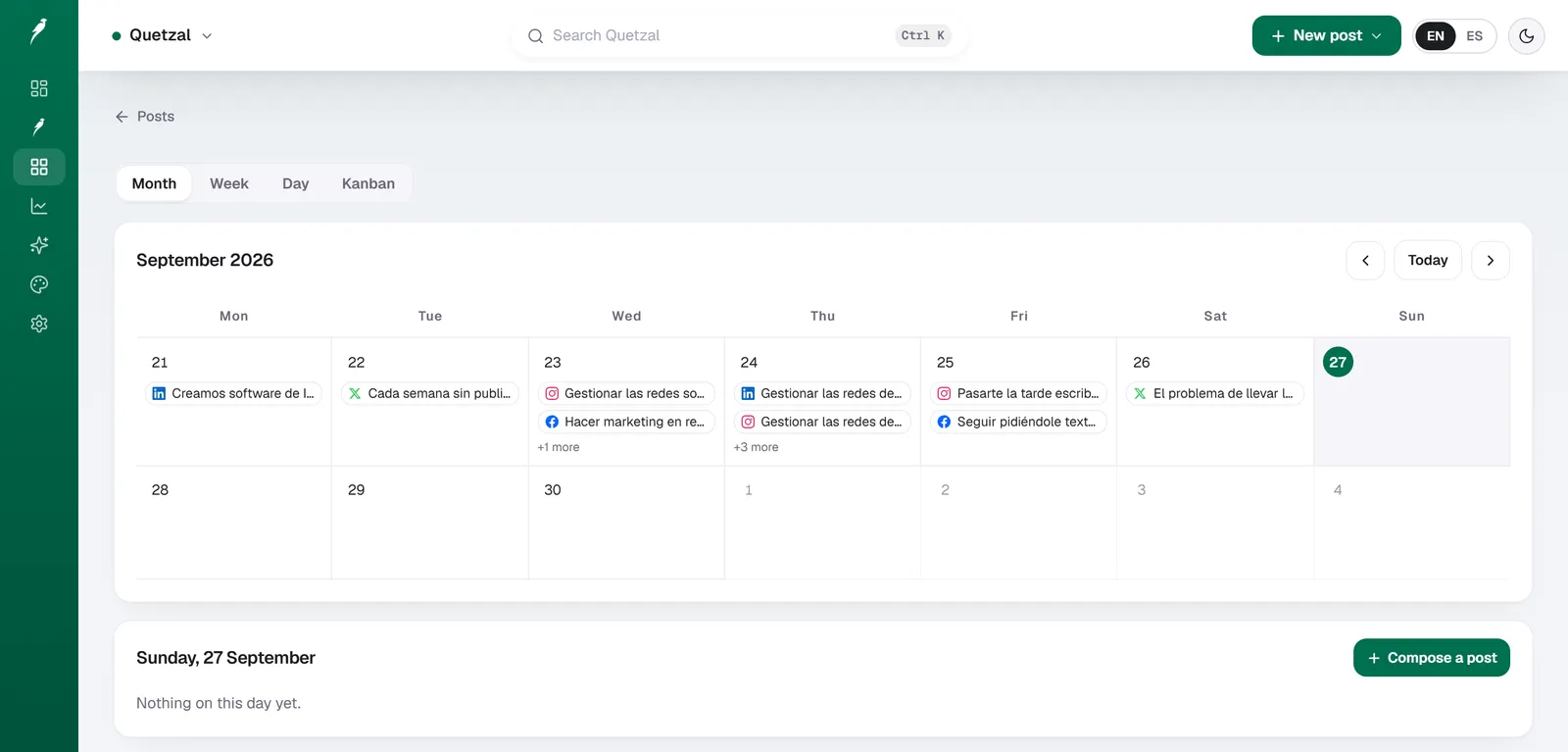
The Quetzal calendar on our own account in September 2026: every post the autopilot planned for LinkedIn, X, Instagram and Facebook, and underneath, the posts still waiting for approval. Our account publishes in Spanish.
Core architectural differences between Agorapulse and Sprout Social
The structural distinction between Agorapulse and Sprout Social stems from how each platform conceptualizes the primary role of a social media team. Agorapulse views social media primarily through an operational lens: responsive community management, clean inbox queues, straightforward publishing calendars, and clear attribution of social traffic.
Its interface minimizes friction for community managers clearing inbound notifications and agencies juggling distinct client accounts.
Sprout Social views social media through an enterprise intelligence and customer relationship management lens. It treats social profiles not merely as marketing channels, but as digital storefronts, brand monitoring outposts, and Tier-1 customer support desks. Consequently, Sprout invests heavily in enterprise CRM connectors, automated message routing, granular audit logs, and cross-channel sentiment analysis.
However, both tools share a common operational assumption: they expect your marketing team to arrive with completed creative assets. Neither platform designs static graphics, renders video reels, or drafts publication-ready copy from raw brand guidelines.
Teams frequently discover that paying for collaborative scheduling seats does not resolve their core bottleneck, which is generating 15 to 20 original visual posts every single week.
Before committing multi-thousand-dollar software budgets to pure distribution tools, testing an automated pipeline on Quetzal's free interactive demo shows how modern generative infrastructure can produce a week of on-brand content in minutes, contrasting sharply with traditional manual asset assembly.
Social inbox mechanics: community management vs customer care
Community engagement workflows represent the starkest functional divergence between the two tools. While both provide a unified inbox aggregating comments, direct messages, and brand mentions, their internal mechanics target completely different team operational rhythms.
Agorapulse built its reputation on an email-style "Inbox Zero" paradigm. In Agorapulse, every inbound interaction is treated as an actionable task.
Incoming comments, reviews, and private messages across connected channels sit in an active queue until a team member assigns, tags, replies to, or explicitly marks them as reviewed. This structure ensures zero customer inquiries slip through the cracks during high-volume campaigns.
Agorapulse also provides advanced ad comment monitoring. It syncs comments left on paid Meta and LinkedIn ad campaigns directly into the same triage queue as organic interactions.
Its automated moderation assistant allows teams to create rule-based triggers that automatically hide spam, assign inquiries containing purchase intent keywords to senior managers, or bookmark sentiment-heavy feedback. Built-in collision detection prevents two community managers from replying to the same user simultaneously.
Sprout Social approaches engagement through its Smart Inbox, engineered for high-volume customer care and cross-functional enterprise departments. The Smart Inbox streams all inbound interactions into a consolidated feed with sophisticated filtering options. Rather than treating items purely as tasks to clear, Sprout allows agents to convert messages into internal customer service tickets.
Sprout Social integrates natively with enterprise help desk suites like Zendesk, HubSpot, and Salesforce Service Cloud. When an angry customer reaches out on X or Instagram, an agent can view the customer's prior CRM history, escalate the conversation into an official support ticket, and track resolution metrics across departments.
For global brands where social media serves as a direct extension of technical support, Sprout's routing sophistication is unmatched. For lean teams or agencies simply looking to moderate conversations quickly, Sprout's ticketing architecture can introduce unnecessary bureaucratic friction.
Social listening, reporting, and ROI attribution
Reporting depth and data extraction capabilities reflect another major divide between operational community tools and enterprise market intelligence platforms.
Sprout Social houses one of the most sophisticated social listening engines in the software landscape. Rather than limiting searches to direct brand mentions, Sprout's listening module queries millions of public conversations across Reddit, YouTube, X, forums, and blogs.
Marketing directors can construct complex boolean search queries to track industry sentiment, monitor competitor share of voice, detect emerging PR crises before they escalate, and identify consumer preference shifts. Furthermore, Sprout's Premium Analytics suite delivers boardroom-ready presentation dashboards with custom branding, deep demographic insights, and comprehensive cross-network benchmarks.
Agorapulse takes a pragmatic approach focused on tangible commercial return and team efficiency. While it offers standard social listening for direct brand mentions, hashtags, and public keywords, it does not attempt to replicate Sprout's web-wide conversational intelligence engine. Instead, Agorapulse excels at direct commercial attribution through its social ROI tracking module.
Agorapulse integrates directly with Google Analytics (GA4) and automates the appending of dynamic UTM tracking codes to every scheduled link. Its reporting dashboard matches web traffic, goal completions, and e-commerce revenue directly back to specific posts, organic campaigns, and even individual inbox responses.
For marketing teams that must defend their retainer or headcount by proving pipeline generation, Agorapulse delivers straightforward attribution without demanding custom business intelligence implementations. Similar to the reporting trade-offs explored in our comparison of Zoho Social vs Buffer, choosing your stack requires deciding whether your leadership values qualitative market sentiment or direct conversion metrics.
Pricing models, seat scalability, and agency economics
Pricing architecture is often the deciding factor when teams compare Agorapulse and Sprout Social. The two platforms utilize fundamentally opposing monetization structures that drastically impact organizational scalability.
Sprout Social relies on a strict per-seat billing model. Every team member who requires access to the platform (social media managers, graphic designers, copywriters, client reviewers, or executive stakeholders) must possess an individually licensed seat.
Because Sprout's standard tiers start at several hundred dollars per seat monthly and scale upward for professional and advanced capabilities, adding team members creates an aggressive cost multiplier.
An agency or marketing department requiring 6 to 10 active seats can easily spend $15,000 to $30,000 annually on Sprout Social before adding optional listening or premium analytics modules.
Agorapulse offers a significantly more accessible pricing model for growing organizations. While it also prices based on user counts and connected social profiles, its core plans bundle multiple user seats and provide incremental seat additions at predictable, modest price points. Furthermore, Agorapulse includes dedicated agency functionality:
- Shared client calendars that permit external client review and approval without forcing agencies to purchase costly full-access seats.
- White-labeled PDF and CSV reporting modules included in standard agency plans.
- Centralized account switching that cleanly segregates client data and permissions.
For marketing agencies evaluating software overhead, managing margins is paramount. Exploring AI software for marketing agencies illustrates how modern service providers are actively restructuring client deliverables away from high per-seat software retainers toward automated production environments.
When team seats carry punitive price tags, organizations frequently resort to dangerous security practices like password sharing or restricting junior team members from scheduling drafts. Similar workflow constraints emerge in our breakdown of Planoly vs Buffer, proving that seat costs inevitably dictate operational governance.
For businesses that determine Sprout's enterprise pricing exceeds their operational requirements, reviewing dedicated Sprout Social alternatives highlights how lean teams capture core publishing workflows at a fraction of the licensing cost.
Feature comparison: Agorapulse vs Sprout Social
The following table synthesizes the architectural, operational, and commercial differences between both platforms.
| Feature Category | Agorapulse | Sprout Social |
|---|---|---|
| Primary Target Audience | Mid-market brands, growing agencies, community managers | Enterprise corporations, large marketing teams, global support centers |
| Inbox Methodology | Inbox Zero task management, ad comment tracking, collision detection | Smart Inbox, CRM ticket routing, cross-department message assignment |
| Ad Comment Monitoring | Native synchronization for Meta and LinkedIn paid ad campaigns | Available on higher tiers, focused on enterprise social support |
| Social Listening Scope | Brand mention monitoring, hashtag tracking, basic sentiment | Web-wide conversational listening, boolean queries, Reddit/forum monitoring |
| Reporting Focus | Social ROI attribution via GA4, UTM automation, team response metrics | Boardroom presentation decks, competitive benchmarking, sentiment trends |
| Pricing Architecture | Bundled tiers with accessible incremental user additions | Strict per-user licensing model with premium add-on fees |
| Agency Features | Free or low-cost client approval access, shared calendars, white-label reports | Formal client management requires purchasing dedicated enterprise seats |
| CRM Integrations | Native hub integrations, lightweight customer profiling | Deep bi-directional sync with Salesforce, Zendesk, and HubSpot |
| Content Creation Engine | Manual scheduling queue; requires pre-made graphics and copy | Manual scheduling queue; requires pre-made graphics and copy |
Source: Platform interface analysis and workflow specifications, 2026.
Content publishing workflows and asset limitations
When examining publishing mechanics, both platforms provide the reliable scheduling infrastructure expected by modern enterprise marketing teams. Each tool supports scheduling across Instagram, Facebook, LinkedIn, TikTok, X, YouTube, and Pinterest.
Agorapulse organizes publishing through visual calendar views, custom queue categories, and evergreen republishing cadences. Queue categories allow social managers to establish recurring themes (such as Tuesday customer testimonials or Thursday educational threads) and fill those buckets with approved content that publishes automatically based on preset time slots.
Sprout Social counters with ViralPost, an algorithmic publishing technology. ViralPost analyzes your historical audience engagement patterns in real time and automatically deploys scheduled content at the precise moment followers are most active online. Sprout also offers sophisticated approval workflows with multi-step managerial sign-offs, legal compliance checks, and comprehensive asset libraries with cloud storage integrations.
Yet despite these publishing refinements, both tools leave the most labor-intensive problem completely unaddressed. Agorapulse and Sprout Social are delivery logistics tools. They do not generate the underlying media.
Before a post can be scheduled in either platform, human team members must:
- Conduct industry research to identify relevant topics and narrative hooks.
- Draft compelling, platform-specific copy tailored to the nuances of LinkedIn versus Instagram.
- Open graphic design software to construct branded static graphics, multi-slide carousels, or infographics.
- Film, cut, script, voiceover, and subtitle vertical video reels for short-form video algorithms.
- Export assets, upload files, and manually align scheduling calendars.
This manual creative assembly requires anywhere from 15 to 30 hours of human production per week per brand.
This production bottleneck is precisely why modern teams are adopting generative autonomous infrastructure alongside or in place of legacy schedulers. Quetzal is an AI social media autopilot built in Málaga, Spain, by two founders.
Instead of acting as an empty calendar awaiting human uploads, Quetzal generates designed static posts, ads, carousels, infographics, stories, and captions in the brand's own visual identity, strictly applying its logo, color palette, typography, and product imagery.
Quetzal publishes across Instagram, Facebook, LinkedIn, TikTok, X, and YouTube, and measures every post at 1, 6, 24, and 72 hours to dynamically refine the next week's creative direction. It also produces end-to-end AI video reels with scripts, AI voiceovers, word-synced subtitles, and fully edited renders.
Teams retain complete control: Quetzal's autopilot can operate autonomously under standing brand guidelines or require human per-post approval before anything goes live. For agencies managing multiple brands, Quetzal provides dedicated workspaces per client with portfolio discounts beginning with the third brand.
How to choose between Agorapulse and Sprout Social for your team
Your selection between these two platforms should align directly with your internal organizational bottlenecks, team size, and commercial priorities.
Choose Agorapulse if:
- You run a digital marketing agency or manage multiple distinct brands and need predictable subscription costs that do not escalate violently with every new hire.
- Your primary operational daily priority is community management, rapid comment moderation, and clearing an inbox to zero.
- You spend money on paid social campaigns and require an integrated solution to catch spam, inquiries, and customer feedback on active ad units.
- You need clear, defensible ROI reporting linking social campaigns directly to website conversions in Google Analytics without purchasing expensive enterprise add-ons.
Choose Sprout Social if:
- You operate a large enterprise marketing department or a dedicated social customer care center with multi-tiered team structures.
- Your social team works hand-in-hand with enterprise support desks and requires bi-directional ticket routing into Salesforce or Zendesk.
- Your executive team demands deep, broad market listening data to track brand sentiment, monitor competitor conversations across forums, and manage PR exposure.
- Your organization possesses an enterprise software budget that comfortably supports several hundred dollars per seat per month.
Bridging the gap between scheduling software and content creation
Choosing between Agorapulse and Sprout Social organizes how your team distributes media, but it leaves the burden of daily graphic design, video editing, and copywriting entirely on your staff. If your business wants to eliminate manual asset assembly and see a full week of branded posts, carousels, and reels produced in three minutes, test Quetzal's free content demo without creating an account.
FAQ
Why is Sprout Social more expensive than Agorapulse?
Sprout Social prices its software on a strict per-seat enterprise model, meaning every single team member requires a distinct paid license. Furthermore, Sprout positions itself as a complete enterprise intelligence hub, bundling advanced CRM connectors, sophisticated workflow governance, and enterprise customer service tools that command higher software budgets than operational community tools like Agorapulse.
Which platform is better for marketing agencies managing multiple clients?
Agorapulse is widely considered the superior choice for agencies because of its agency-friendly pricing tiers, bundled user seats, and free external client approval calendars. In contrast, Sprout Social requires agencies to purchase full-price seats for additional team members or clients who need direct platform access, which can severely erode agency profit margins.
Can Agorapulse and Sprout Social monitor comments on paid social media ads?
Yes, both platforms support ad comment monitoring, but Agorapulse provides it as a core competency natively integrated into its Inbox Zero triage workflow. Agorapulse automatically pulls comments from Meta and LinkedIn dynamic ad campaigns into your active moderation queue, enabling community managers to delete spam or answer product questions directly from the dashboard.
Do Agorapulse or Sprout Social create social media graphics or video reels?
No. Neither Agorapulse nor Sprout Social generates content, creates graphics, or edits video reels. Both platforms are distribution and engagement engines that require your team to design images in external creative tools, write captions manually, and edit video files before uploading them to their scheduling queues.
Sources
- Agorapulse Platform Architecture and Social Inbox Specifications (2026)
- Sprout Social Product Documentation and Enterprise Seat Licensing Guidelines (2026)