Comparison · October 1, 2026
SocialPilot vs Metricool: 2026 Platform Comparison
SocialPilot vs Metricool: Compare pricing, analytics, client approval workflows, and publishing features to find the best tool for your team in 2026.
 By Sergio · Co-founder of Quetzal

SocialPilot suits agencies needing robust client approvals, bulk scheduling, and multi-user delegation across dozens of social profiles. Metricool suits creators, small businesses, and performance marketers wanting deep cross-platform analytics, ad campaign tracking, and affordable per-brand pricing. Neither generates production-ready creative assets autonomously; both remain manual scheduling dashboards.
Managing multiple social media channels across different platforms requires choosing between distinct software architectures. Some platforms prioritize operational logistics like team permissions and queue management, while others focus on quantitative depth, unified analytics, and multi-channel campaign tracking. Evaluating SocialPilot against Metricool highlights this fundamental operational divide.
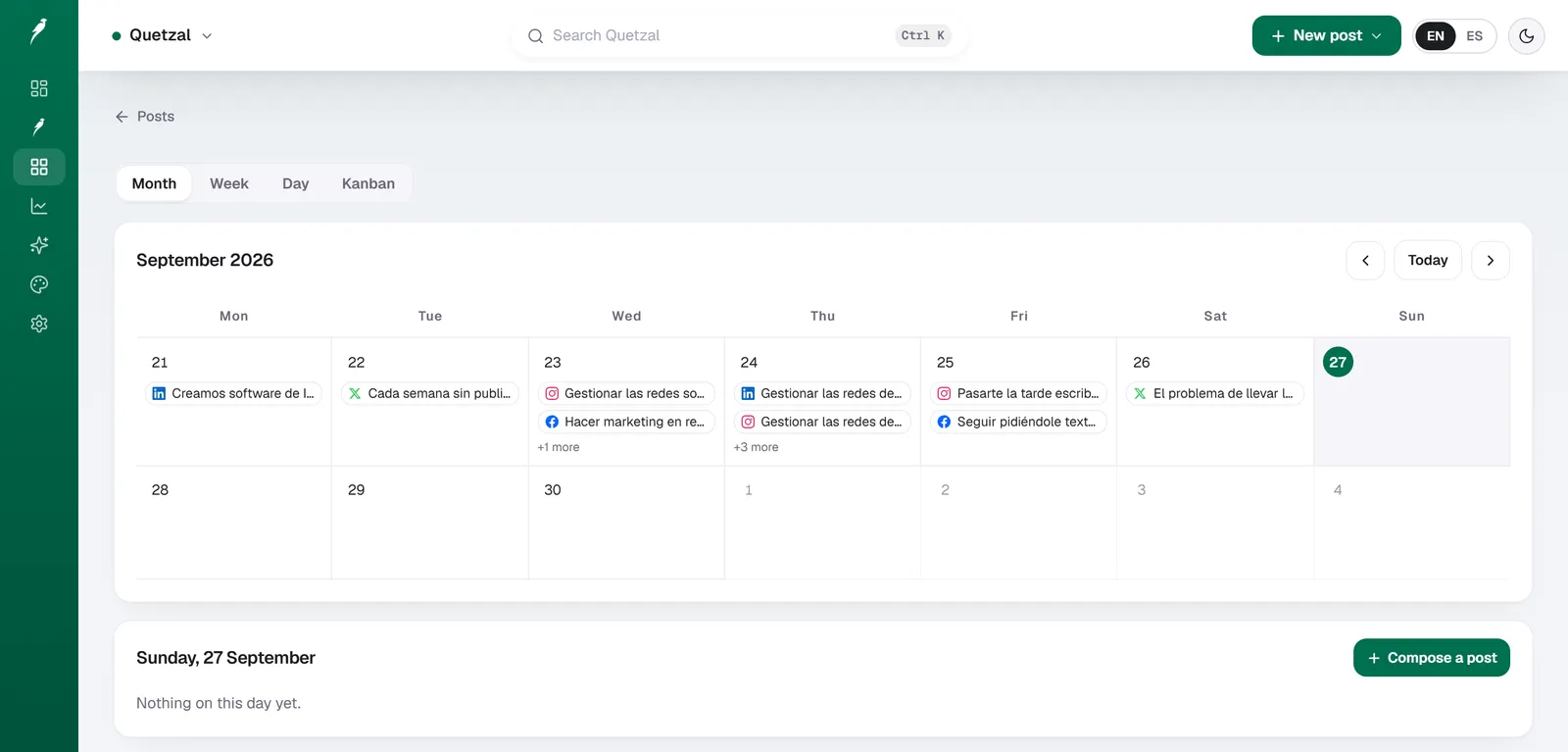
The Quetzal calendar on our own account in September 2026: every post the autopilot planned for LinkedIn, X, Instagram and Facebook, and underneath, the posts still waiting for approval. Our account publishes in Spanish.
Core differences between SocialPilot and Metricool
SocialPilot is engineered around team and agency operations. Its core strength lies in streamlining the logistical pipeline of content distribution: organizing social accounts into distinct client groups, setting up tiered access permissions for junior staff, collecting client approvals without forcing clients to log into complex software, and uploading hundreds of updates at once via bulk scheduling spreadsheets.
Metricool approaches social media management through an analytics-first lens. Originally built to unify digital performance metrics, Metricool aggregates organic social interactions, paid ad performance (Meta Ads, Google Ads, TikTok Ads), and website visitor telemetry into a single interface. Its publishing calendar functions as a distribution node layered on top of a comprehensive business intelligence system.
The distinction between these two systems becomes evident in daily operations:
- SocialPilot prioritizes agency workflow velocity: It simplifies posting across high volumes of accounts with minimal friction, clean approval handoffs, and team seat scalability.
- Metricool prioritizes data consolidation: It monitors the entire conversion funnel by linking social engagement, competitor performance, website analytics, and paid media returns.
- Content production remains manual in both: Neither platform designs graphics, produces video reels, or writes visual carousels. Both tools assume your creative assets are fully finished before scheduling begins.
Teams evaluating these tools must determine whether their primary operational bottleneck is managing client communication and high-volume posting, or tracking multi-channel performance and ad spend.
Pricing structure and value: Per-brand versus per-channel models
The economic difference between SocialPilot and Metricool stems from how each vendor calculates account limits and platform access.
Metricool prices its service primarily on "brands." In Metricool's terminology, a brand represents an entire bundle of social profiles belonging to one entity (for example, one brand includes one Instagram account, one Facebook page, one LinkedIn company page, one TikTok account, one YouTube channel, one X account, one Google Business Profile, and associated ad accounts).
According to the Metricool pricing page, users can start with a permanent free plan covering a single brand with limited historical data (three months) and a cap of 50 scheduled posts per month.
Paid tiers, such as the Starter and Advanced plans, increase the brand allotment (starting at 5 brands for roughly 18 USD per month billed annually) while unlocking unlimited historical reporting, customizable templates, and multiple team members.
SocialPilot calculates pricing based on user seats and the total count of connected social profiles, regardless of whether those profiles belong to the same business or different clients. As outlined on the SocialPilot pricing page, there is no permanent free tier.
Instead, SocialPilot offers tiers starting with Professional (around 25.50 USD per month billed annually for 1 user and up to 10 social accounts), scaling up to Small Team (around 42.50 USD per month billed annually for 3 users and 20 accounts), Agency (around 85 USD per month billed annually for 6 users and 30 accounts), and Agency+ (around 170 USD per month billed annually for unlimited users and 50 accounts).
| Feature / Dimension | Metricool | SocialPilot |
|---|---|---|
| Pricing Model | Per brand (bundle of multi-platform profiles) | Per social profile and user seat |
| Free Tier | Yes (1 brand, 50 posts/month, 3-month history) | No (14-day trial only) |
| Entry Paid Plan (Annual) | ~$18/month (Starter, 5 brands) | ~$25.50/month (Professional, 10 accounts, 1 user) |
| Agency Tier (Annual) | Custom / Advanced scaling by brand count | ~$85 to $170/month (30–50 accounts, multi-seat) |
| Ad Campaign Tracking | Native (Meta, Google, TikTok Ads) | Not supported (organic post analytics only) |
| Client Approval Workflows | Available on Advanced/Custom plans | Core focus across all team plans |
| White-Label Reporting | Available on higher tiers | Available on Agency and Agency+ tiers |
Source: Metricool pricing and SocialPilot pricing, 2026.
Metricool provides a significantly lower cost of entry for businesses managing a single business entity with multiple social handles. SocialPilot becomes more cost-predictable for agencies managing dozens of standalone accounts where client approvals and team seat management outweigh the need for paid advertising analytics.
Scheduling, visual planning, and content management
When staging content inside SocialPilot, the user experience is built for rapid queue population. SocialPilot features a robust bulk scheduler that allows teams to upload up to 500 posts simultaneously via a formatted CSV file, including scheduled times and custom image links.
It also provides native RSS feed automation, enabling agencies to syndicate blog feeds directly into social drafts. Its visual calendar provides day, week, and month views, with post queues clearly separated by account groups.
Metricool centers its scheduling workflow on performance timing. Its calendar includes interactive heatmaps that display the exact hours your specific audience is online and active across Instagram, Facebook, and TikTok. Rather than relying on generic industry benchmarks, Metricool calculates these percentages from your historical profile data.
Both platforms support modern video formats, including direct auto-publishing for Instagram Reels, TikTok videos, YouTube Shorts, and LinkedIn documents. Metricool includes an integrated "SmartLinks" feature, which functions as a link-in-bio tool allowing users to map specific Instagram posts to external product pages or blog articles.
SocialPilot handles URL customization via integrations with link shorteners (like Bitly and Sniply), but does not feature a dedicated, post-mapped link-in-bio landing page builder.
For teams comparing different visual scheduling tools across the market, workflows can vary significantly. As explored in our comparison of Planoly vs Buffer, visual-first schedulers often sacrifice deep queue automation in favor of grid aesthetic planning. SocialPilot leans hard into queue automation, while Metricool balances visual calendar planning with audience activity data.
Analytics and reporting: Where Metricool pulls ahead
Analytics is the area where the two platforms diverge most sharply.
Metricool functions as a unified reporting dashboard for your entire digital footprint. Beyond standard post metrics (impressions, reach, likes, comments, and shares), Metricool tracks:
- Competitor bench-marking: Monitor competing profiles on Instagram, Facebook, YouTube, and Twitch to evaluate follower growth and content cadence.
- Paid advertising performance: Connect Meta Ads, Google Ads, and TikTok Ads to view spend, impressions, clicks, CPC, and conversion metrics alongside organic social posts.
- Web analytics: Install a lightweight tracking script on your website to monitor page views, visitors, and referrers directly inside the Metricool dashboard.
- Google Business Profile insights: Track local search queries, map directions, and customer review velocity.
SocialPilot's analytics are tightly focused on organic social performance. It produces clear, easily readable reports covering audience demographics, engagement growth, top-performing content formats, and optimal posting times.
On Agency and Agency+ plans, SocialPilot allows users to generate fully white-labeled PDF reports, complete with the agency's logo, color palette, and custom branding, which can be automatically emailed to clients on a recurring schedule.
However, SocialPilot does not ingest paid ad data or website traffic. Even major vendors acknowledge the distinct focus of Metricool's data model; in Hootsuite's own comparison, Hootsuite positions Metricool as an entry-to-mid-tier analytics platform compared to enterprise listening suites. Yet for small-to-mid-sized teams, Metricool delivers more comprehensive cross-channel intelligence than SocialPilot.
Teams weighing analytics depth against scheduling simplicity will notice similar trade-offs across other tools, as documented in our analysis of Zoho Social vs Buffer.
Client management and collaboration: Where SocialPilot excels
For marketing agencies managing a roster of external clients, operational friction usually occurs around approvals, revisions, and account access. This is where SocialPilot demonstrates clear workflow advantages.
SocialPilot includes a dedicated client onboarding system. Rather than requesting client passwords or forcing clients through complex platform handshakes, agencies can send an onboarding link. The client securely connects their own social profiles, which immediately link into the agency's SocialPilot dashboard.
Furthermore, SocialPilot's approval engine separates internal and external review stages:
- Content creators can draft posts and assign them to an internal manager for initial review.
- Managers can approve drafts or return them with inline comments.
- Once internally approved, drafts can be shared with external clients via a direct preview link. The client can approve or reject posts with feedback without needing a SocialPilot user seat or logging in.
Metricool offers multi-user management and role-based permissions on its Advanced and Custom plans, but its approval flow is simpler. Metricool allows users to assign statuses (such as Draft, Pending Review, or Approved) within the calendar, but it lacks the frictionless, no-login client approval interface that makes SocialPilot a favorite among high-volume agency operations.
Agencies seeking deeper operational automation across their entire workflow often review dedicated agency management software to eliminate these manual administrative steps entirely.
The content creation gap: Scheduling versus full autopilot
While SocialPilot and Metricool provide capable tools for organizing, distributing, and analyzing social media, both platforms suffer from the same foundational limitation: they are passive distribution engines.
Neither SocialPilot nor Metricool creates the media that fills your queue. To keep either scheduler active, marketing teams must manually execute every step of the creative production process:
- Brainstorming weekly editorial concepts across different channels.
- Designing branded carousels, static graphics, and infographics in tools like Canva or Photoshop.
- Writing platform-optimized copy, hooks, and hashtags for each network.
- Scripting, recording, voiceover-editing, and caption-syncing video reels.
- Uploading each completed asset into the scheduler and selecting posting dates.
When marketing teams fall behind on content creation, their schedulers simply sit empty.
This operational bottleneck is why many teams evaluate an entirely different class of software: social media autopilots. Quetzal approach social media from the opposite direction. Rather than acting as an empty calendar awaiting manual uploads, Quetzal operates as an AI social media autopilot.
Built in Málaga, Spain, by two founders, Quetzal takes a brand's visual identity (logo, color palette, typography, and product photography) and autonomously generates production-ready assets: designed static posts, ad creatives, multi-slide carousels, infographics, stories, and platform-specific captions. It also generates complete AI video reels end to end, including scriptwriting, realistic AI voiceover, word-synced subtitles, and final video rendering.
Once generated, Quetzal automatically schedules and publishes content across Instagram, Facebook, LinkedIn, TikTok, X, and YouTube. To ensure brand safety, businesses can run Quetzal in two modes: fully autonomous publishing under strict standing brand guidelines, or with per-post human approval.
Furthermore, Quetzal measures the performance of every post at 1, 6, 24, and 72 hours, feeding engagement data directly back into the creative engine to refine the next week's output.
For teams that already possess dedicated design and copywriting departments, a traditional scheduler like SocialPilot or Metricool works well. But for organizations that struggle to produce high-quality visual content consistently, scheduling software only solves half the problem.
How to choose between SocialPilot and Metricool
Selecting the right platform depends entirely on your team's operational structure, existing tool stack, and reporting requirements.
Choose Metricool if:
- You manage 1 to 15 distinct brands and want predictable, affordable subscription pricing.
- You need unified reporting that combines organic social reach, website traffic, and paid advertising spend across Meta, Google, and TikTok Ads.
- You want to use interactive, audience-specific activity heatmaps to optimize your publishing schedule.
- You need an integrated link-in-bio builder that connects specific Instagram posts to external URLs.
- You need a capable free plan to manage a single brand before committing budget.
Choose SocialPilot if:
- You run a digital marketing agency managing dozens of standalone social accounts across multiple clients.
- Your workflow requires formal, multi-stage approval processes with frictionless, no-login client review links.
- You frequently schedule high volumes of content using bulk CSV spreadsheets and RSS automation feeds.
- You require fully white-labeled analytics reports and client portals branded with your agency's identity.
- You need flexible team seat structures with granular role permissions for content creators and managers.
From manual scheduling to automated production
Choosing between SocialPilot and Metricool determines how you manage your content pipeline, but keeping either calendar filled still demands hours of manual writing, graphic design, and video editing every week. To see how an autonomous autopilot can handle both content production and multi-platform publishing for your business in a single workflow, test your website on the Quetzal demo to generate an entire week of fully branded social content in about a minute.
FAQ
Does Metricool or SocialPilot offer a better free plan?
Metricool offers a significantly better free tier, allowing users to connect one brand (comprising multiple social networks) with up to 50 scheduled posts per month and three months of analytics history. SocialPilot does not offer a permanent free plan; it only provides a 14-day free trial across its paid commercial subscription tiers.
Can SocialPilot and Metricool publish TikTok videos and Instagram Reels directly?
Yes, both SocialPilot and Metricool support direct, automated publishing for short-form video formats, including TikTok videos, Instagram Reels, YouTube Shorts, and Facebook Reels. Neither platform requires manual push notifications via a mobile app for standard video publishing, provided the uploaded video files meet each network's duration and dimension specifications.
Which platform is better for white-label agency reports?
SocialPilot is better suited for white-label agency reporting, as its Agency and Agency+ plans allow teams to fully remove SocialPilot branding, apply custom agency logos and color schemes, and automatically email reports to clients from custom domains. Metricool provides clean, customizable PDF and PPT reports on its Advanced plans, but its white-labeling and client review workflows are less comprehensive than SocialPilot's dedicated agency infrastructure.
Do SocialPilot or Metricool generate images and video content automatically?
No, neither SocialPilot nor Metricool generates finished graphic designs or video reels automatically. Both platforms include basic AI text assistance to help users brainstorm captions or rewrite copy, but marketing teams must supply their own completed images, videos, carousel slides, and creative assets prior to scheduling.
Sources
- Metricool pricing: https://metricool.com/pricing/
- SocialPilot pricing: https://www.socialpilot.co/pricing
- Hootsuite vs Metricool: https://www.hootsuite.com/hootsuite-vs-metricool